English
 русский
 Español
When you walk into a newly built oral solid dosage plant, the first things that catch your eye are usually not the process equipment, but the clean room doors that quietly separate different classified areas. They endure hundreds of open-and-close cycles every day, repeated disinfection, and constant airflow disturbance. During a GMP audit, inspectors look closely at the condition of the door seals, surface scratches, and dust accumulation around frames. Any small defect can become a written observation in the audit report.
Let us state the conclusion upfront: the evaluation of pharmaceutical clean room doors should focus on four dimensions — sealing performance, surface cleanability, material compatibility, and operating mode. These four factors determine whether your facility can maintain the required cleanliness class, pass regulatory inspections, and keep lifecycle costs under control over the next decade.
Content
Why Pharmaceutical Clean Room Doors Are Central to GMP Compliance
EU GMP Annex 1 (2022 revision) and FDA 21 CFR Part 211 both require that pharmaceutical manufacturing facilities be designed to prevent contamination and cross-contamination. Clean room doors are part of the containment boundary, with three main responsibilities: maintaining pressure differentials, blocking particles, and preventing contaminants from entering when personnel and materials pass through.
In the cleanroom envelope, doors are the most frequently used component and the most prone to performance degradation. Walls and ceilings are fixed structures whose performance remains stable after installation, but a door opens and closes hundreds of times per day. Seals wear out, the door leaf can sag, hinges loosen, and the floor track of a sliding door can collect dust. From a risk-management perspective, the door is the weakest link in the contamination control chain.
ISO 14644-4 provides guidance on the design of cleanroom enclosures, including air tightness, surface flatness, and material outgassing characteristics. For pharmaceutical applications, door surfaces should minimize particle accumulation while tolerating frequent cleaning and disinfection with aggressive agents such as VHP, peracetic acid, and alcohol-based solutions.
One often-underestimated trend deserves attention: the 2022 revision of EU GMP Annex 1 raised the Contamination Control Strategy (CCS) to a new level. CCS requires companies to systematically identify and assess all potential contamination risks instead of relying only on final product testing. Door material, opening method, and maintenance frequency are now elements that must be documented and justified within the CCS framework. In other words, door selection is no longer a purely engineering decision — it has entered the quality system. For reference on how doors and other barriers are handled in real pharmaceutical projects, you can look at documented biopharmaceutical cleanroom solutions that address classification, airflow, and material flow together.
Core Design and Performance Requirements
Airtightness and Pressure Differential Control
Maintaining the correct pressure differential between adjacent areas is the primary mechanism for preventing cross-contamination in pharmaceutical cleanrooms. The sealing performance of a door directly determines whether a room can hold its designated pressure. For adjacent areas with different cleanliness classes, a pressure differential of 10–15 Pa is typical; for corridors versus core production rooms, the requirement may be higher and should be validated during commissioning.
The sealing strip is the critical component. Pharmaceutical clean room doors commonly use EPDM or silicone gaskets. EPDM offers better abrasion resistance, while silicone is more stable at extreme temperatures and often preferred in VHP-decontaminated areas. The compression ratio of the gasket determines how tightly the door leaf meets the frame, and this must be adjusted through the hinges and lock points during installation. Uneven compression creates gaps that show up as pressure differential alarms and particle excursions.
Another detail that installers often overlook is the bottom seal. Floors are never perfectly flat, especially epoxy or PVC flooring near door openings may have slight slopes. An automatic drop seal lowers when the door closes and fills the gap under the leaf, effectively reducing cross-zonal airflow leakage. Without this feature, a 5 mm gap under an otherwise sealed door can compromise the entire pressure cascade.
Surface Finish and Cleanability
Door surfaces in pharmaceutical environments must be easy to clean and disinfect while allowing no particle accumulation. The surface should be smooth, free of pores and sharp corners. Common surface treatments include powder coating, anti-fingerprint coating, and brushed or mirror-polished stainless steel.
Pay special attention to accessories mounted on the door leaf. Vision panels, reinforcement ribs, and nameplates, if poorly designed, become dust traps. A well-designed clean room door integrates the vision panel flush with the leaf, uses concealed hinges, and has handles shaped for easy wiping. Surface roughness is another measurable indicator: stainless steel door leaves typically should have a Ra value between 0.4 and 0.8 μm, and mirror-polished surfaces can reach lower values.
Vision Panels and Special Configurations
Sealed vision panels are common in pharmaceutical cleanrooms. They allow operators to observe room conditions without entering and reduce the number of door openings. Panels should use tempered or laminated glass, and the frame must be sealed against the door leaf to prevent dust from a double-glazed cavity from entering the clean area.
Other configurations include electrical interlocking, electromagnetic locks, door closers, and door stops. Emergency exit doors must open outward during an alarm while remaining tightly sealed during normal operation. These competing requirements test the design capability of the manufacturer. The table below summarizes the main design requirements for doors in different classified zones.
| Cleanliness Zone | Surface Requirement | Sealing Requirement | Common Door Type | Special Consideration |
|---|---|---|---|---|
| Grade A/B (aseptic core) | Stainless steel, mirror finish, low Ra | Full-perimeter gasket, automatic bottom seal | Stainless steel door, automatic sliding door | VHP-resistant; no dead corners |
| Grade C/D (clean support) | Powder-coated steel or stainless steel | Full-perimeter gasket | Steel clean door, stainless steel door | Disinfectant-resistant gasket; reliable locking |
| Controlled non-classified area | Powder-coated steel | Basic perimeter sealing | Steel clean door, aluminum alloy door | Durability and easy maintenance |
Choosing the Right Door Material
Material selection is where many purchasing decisions become difficult, because the visible cost difference is only part of the story. The same door model in different materials can behave very differently over five years of daily use. The following sections compare the three mainstream choices for pharmaceutical clean rooms.
Steel Clean Room Doors
Steel clean room doors are the most widely used type in pharmaceutical facilities, especially for oral solid dosage lines, packaging rooms, and raw material warehouses. The steel substrate gives the door high strength and allows a flat, stable leaf. Powder-coated surfaces offer a wide range of colors and textures. For corridors where carts and forklifts pass frequently, steel doors handle impact far better than aluminum.
When evaluating steel doors, check the galvanized steel sheet thickness, the powder coating process, and the core filling material. Handmade steel doors are customized to actual site dimensions and offer maximum flexibility, while machine-made doors provide better dimensional consistency and production efficiency. Construction quality matters: a door leaf formed by overall bending is stronger than a welded assembly, internal reinforcement ribs prevent surface deformation, and the core material should be fire-retardant.
Poorly made steel doors will show rust at scratched edges within months, and the powder coating may peel when exposed to aggressive disinfectants. A quality powder coating with proper pretreatment is therefore not an option but a requirement.
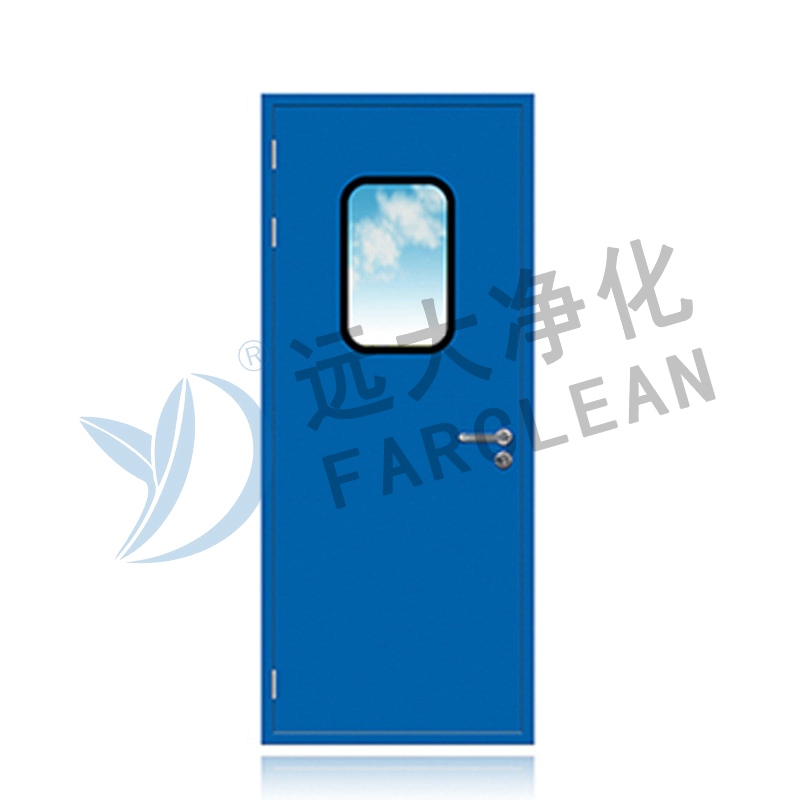 Handmade Steel Clean Room Doors for Harsh Washdown AreasThis steel cleanroom door is built to withstand humid environments and frequent acid or alkaline cleaning. Available in single, double, and unequal configurations, it suits dispensing and sampling rooms where durability is critical.View Product →
Stainless Steel Clean Room Doors
In dispensing rooms, washing rooms, and sampling rooms where humidity is high and acid or alkaline cleaners are used frequently, stainless steel clean room doors are the more reliable choice. Grade 304 stainless steel performs well in most cleanroom environments, but if your cleaning protocol includes high concentrations of chlorides, grade 316L is preferred. The molybdenum addition in 316L provides much stronger resistance to pitting and stress corrosion cracking.
Surface finish also matters. Brushed stainless steel hides minor scratches well, while mirror-polished surfaces make stains easier to spot, at a higher fabrication cost. Considering that pharmaceutical areas need regular VHP or alcohol disinfection, the long-term stability of stainless steel under these agents is unmatched by painted carbon steel. One recommendation: choose stainless steel hardware on stainless steel doors to avoid galvanic corrosion at contact points.
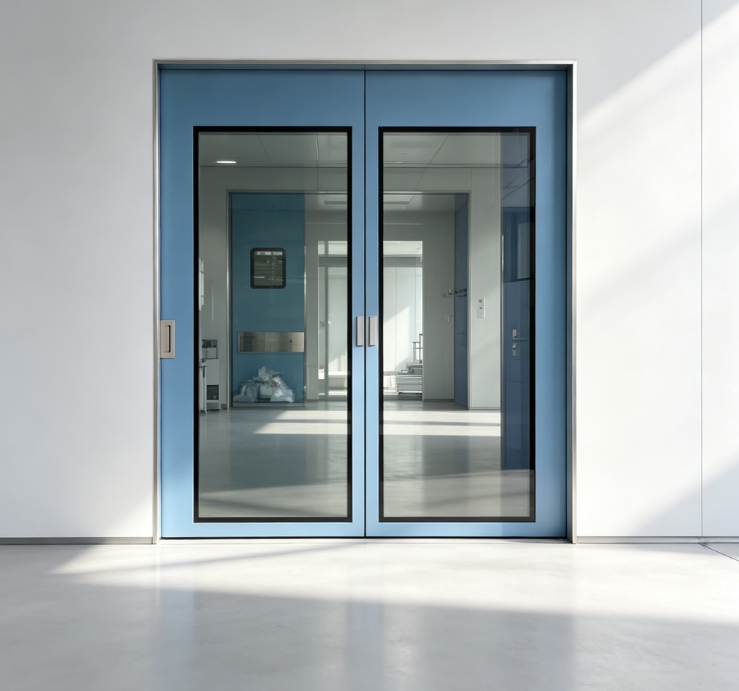
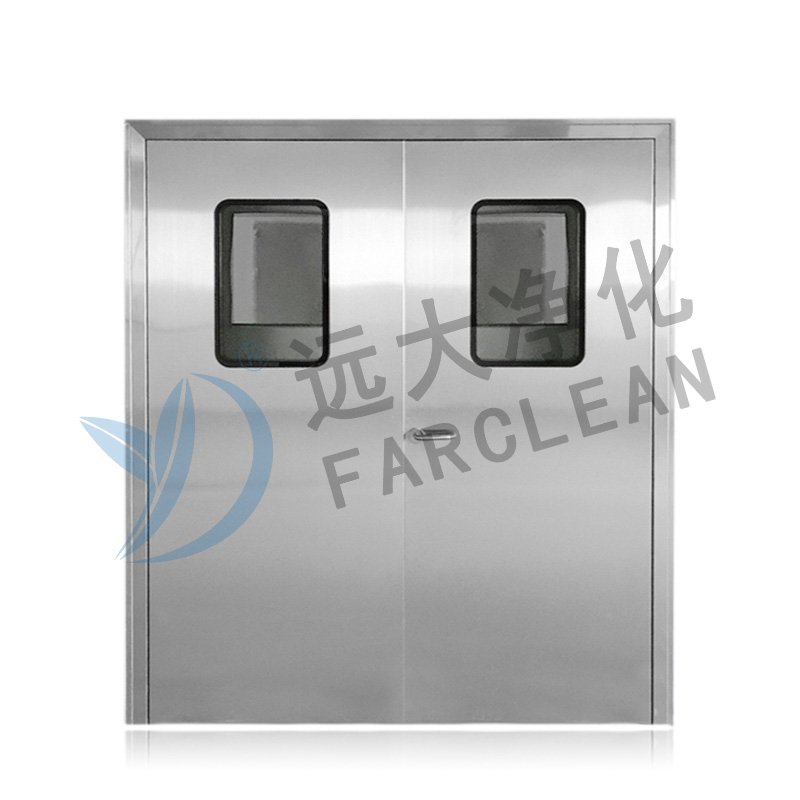 Stainless Steel Cleanroom Door with Double-Glazed Window and Lifting SealFeaturing corrosion-resistant stainless steel, a fog-free double-glazed window, and an automatic lifting seal, this door maintains tight sealing and withstands frequent VHP or alcohol disinfection, making it reliable for pharmaceutical areas.View Product →
Aluminum Alloy Clean Room Doors
Aluminum alloy clean room doors are valued for their light weight and corrosion resistance. In laboratories, R&D areas, or openings where heavy doors are difficult to install, aluminum is a practical choice. Anodized or powder-coated surfaces improve hardness and wear resistance, but the material is softer than steel and will show dents after impacts.
When specifying aluminum doors, pay attention to the wall thickness of the profiles and the overall frame structure. A thin profile may sag after installation, leading to poor sealing and a misaligned lock. If the environment contains aggressive chemical vapors, confirm with the manufacturer that the surface treatment is suitable. For most wash-down areas, stainless steel remains the safer choice, but for low-traffic laboratories, aluminum alloy offers attractive cost savings without compromising cleanliness.
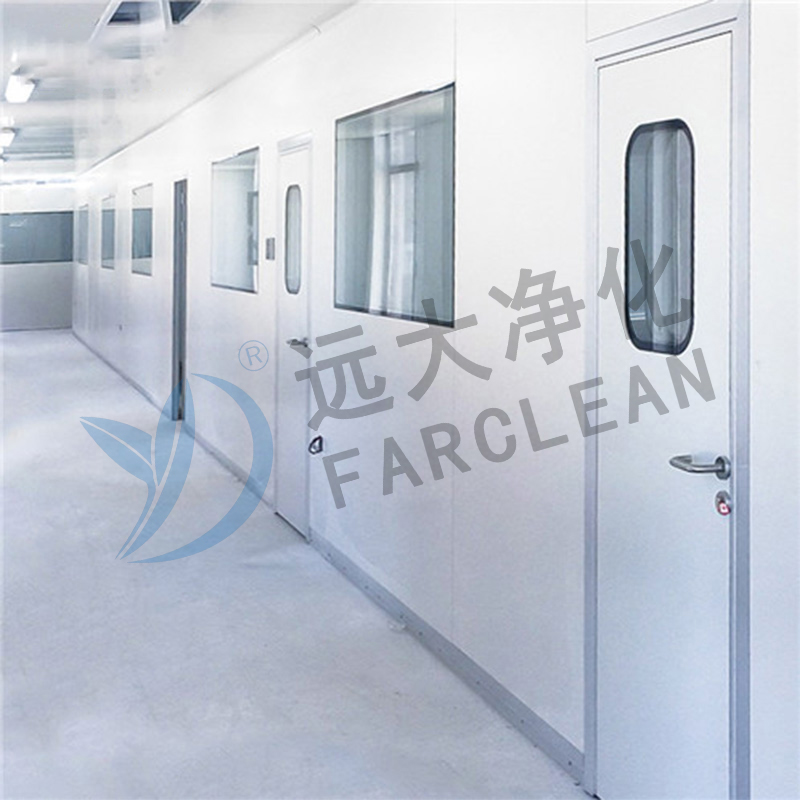 Aluminum Alloy Cleanroom Door with Optional Glass WindowA lightweight aluminum door with high-strength frame, hole-free panel, and sealed window options. It offers corrosion resistance, cost savings, and dependable sealing, ideally suited for low-traffic laboratories and R&D areas.View Product →
| Door Material | Corrosion Resistance | Impact Resistance | Weight | Relative Cost | Recommended Areas |
|---|---|---|---|---|---|
| Steel clean door | Medium (coating-dependent) | High | Heavy | Low to medium | Oral solid dosage, packaging |
| Stainless steel door | High (especially 316L) | High | Heavy | High | Dispensing, washing, aseptic areas |
| Aluminum alloy door | Medium to high | Low | Light | Medium | Laboratory, R&D, low-traffic passage |
Automation, Interlocking, and Workflow Efficiency
Automation brings immediate benefits to pharmaceutical cleanrooms, and the most obvious one is the elimination of touch points. Every contact between a hand and a door handle transfers skin cells and microorganisms to the surface, and in practice it is impossible to disinfect every handle after each touch. Automatic sliding doors operated by sensors or foot pedals remove this contamination route entirely. The tightening requirements of EU GMP Annex 1 on reducing manual intervention in aseptic areas reinforce this trend.
Interlocking systems are another practical tool against cross-contamination. In an interlocked doorway, when one door is open, the opposite door remains locked, preventing an open airflow channel between two zones. When large materials need to pass through, a delay timer gives the operator enough time without compromising the air cascade.
For production areas with constant material movement, a high-speed automatic door can minimize the time the opening remains exposed while maintaining the seal. However, automatic doors are not always the right answer: if maintenance is neglected, the floor track and sensors can become new sources of contamination. Evaluate the actual traffic pattern before committing to automation.
Practical Procurement Considerations
Several points in the purchasing process have a disproportionate impact on long-term satisfaction. These are the ones we see overlooked most often:
- Hardware quality: the door closer, hinges, and lock are the most heavily used parts of any door. Inexpensive hardware may show loose hinges, poor latching, and sagging within six months. Specify the brand and model of the hardware in your purchase contract.
- Installation workmanship: installation quality is as important as the door itself. The gap between the door frame and the wall panel must be filled with sealant, and the clearance between the door leaf and frame must be adjusted to the specified range. Verify the door seals correctly and opens smoothly before accepting the work.
- Validation documentation: pharmaceutical projects typically require installation qualification (IQ) and operational qualification (OQ) documents. A manufacturer that can supply material certificates, surface treatment reports, and installation guidance files will reduce the workload of project acceptance significantly.
- Custom fabrication capability: cleanroom door openings are rarely standard sizes. Your supplier should provide detailed measurement guidance and a clear drawing approval process before production.
For additional details on specification and compliance across different scenarios, the clean room door selection and compliance guide covers the practical differences between finishing choices, sealing grades, and documentation expectations.
Installation, Maintenance, and Lifecycle Costs
The lifecycle cost of a clean room door is often underestimated. The purchase price is just the starting point. Ongoing expenses for cleaning, maintenance, gasket replacement, and closer adjustment will follow for years, and in a classified pharmaceutical area, each maintenance intervention is also a contamination risk.
A simple benchmark: gasket life usually ranges from one to three years, depending on opening frequency, the chemical composition of the disinfectants, and whether the gasket is exposed to UV light. As gaskets age and harden, sealing performance declines and appears as unstable pressure differentials or elevated particle counts. Regular gasket inspection should be a standard item in the facility maintenance schedule.
Think about repairability at the installation stage. Can the door leaf and frame be disassembled easily? Is the gasket clip-in or adhesive-backed? Is the automatic door controller accessible without special tools? Every hour saved during a maintenance shutdown is valuable in a production environment.
In the long term, choosing a more durable surface finish and stainless steel hardware usually pays off through reduced cleaning time and fewer replacement cycles. In aseptic areas, where every maintenance event carries risk, reducing the frequency of interventions is itself a contamination control measure.
Selecting pharmaceutical clean room doors is not like buying standard industrial doors from a catalog. It is a decision that affects GMP compliance, contamination control, operator workflow, and maintenance cost for many years. When you define your cleanliness class, disinfection method, opening frequency, and regulatory expectations first, the right door type becomes evident. Work with a manufacturer that understands both the regulatory side and the manufacturing side; that combination is what keeps a cleanroom stable from the day it starts operation.