English
 русский
 Español
A door for a clean room is not a standard architectural door. It is a precision-engineered component that maintains the air pressure differential, particle count, and contamination control requirements of the controlled environment it serves. Choosing the wrong cleanroom door — or installing a standard door where a cleanroom-rated one is required — directly undermines ISO classification compliance, risking product contamination, failed audits, and costly remediation. The correct door selection depends on the room's ISO class, traffic frequency, pressure differential, chemical exposure requirements, and whether personnel or materials are the primary users.
Content
- 1 Why Cleanroom Doors Are a Critical Contamination Control Component
- 2 Types of Cleanroom Doors: Matching Design to Application
- 3 Cleanroom Door Materials: What the Door Is Made From Matters
- 4 Sealing Systems: The Detail That Determines Cleanroom Door Performance
- 5 Vision Panels in Cleanroom Doors: Requirements and Options
- 6 Hardware and Accessories: Every Component Must Be Cleanroom-Compatible
- 7 Cleanroom Door Standards and Regulatory Compliance
- 8 Cleanroom Door Selection by ISO Classification
- 9 Installation, Qualification, and Ongoing Maintenance
Why Cleanroom Doors Are a Critical Contamination Control Component
Every opening in a cleanroom envelope is a potential contamination pathway. When a door opens, it temporarily equalizes pressure between the controlled space and the adjacent area — allowing unfiltered air, particles, and microorganisms to migrate inward if the door, its seals, and its operating speed are not engineered to minimize this exchange. For high-classification cleanrooms (ISO 5 and above), even brief, uncontrolled pressure equalization events can introduce enough particles to require requalification of the space.
Cleanroom doors also generate particles themselves. A standard hollow-core door with conventional hinges and a painted wood surface sheds paint particles, wood fibers, and lubricant aerosols with every use. Cleanroom-rated doors are constructed from non-shedding, non-outgassing materials — typically steel, aluminum, or reinforced polymer — with smooth, cleanable surfaces and sealed edges that do not emit particulates under normal operating conditions.
Beyond particle control, cleanroom doors must maintain consistent pressure differentials. Most pharmaceutical and semiconductor cleanrooms operate at positive pressure (typically +12.5 to +25 Pa above adjacent spaces) to prevent external contaminants from entering when a door is opened. Bio-containment facilities reverse this to negative pressure to prevent egress of biological material. The door must be airtight enough when closed to sustain these differentials without excessive HVAC compensation.
Types of Cleanroom Doors: Matching Design to Application
There are several distinct types of cleanroom doors, each suited to specific operational scenarios. Selecting the wrong door type — even if the door is technically cleanroom-rated — creates operational inefficiencies, seal degradation, and contamination risks over time.
Swing Doors (Hinged Doors)
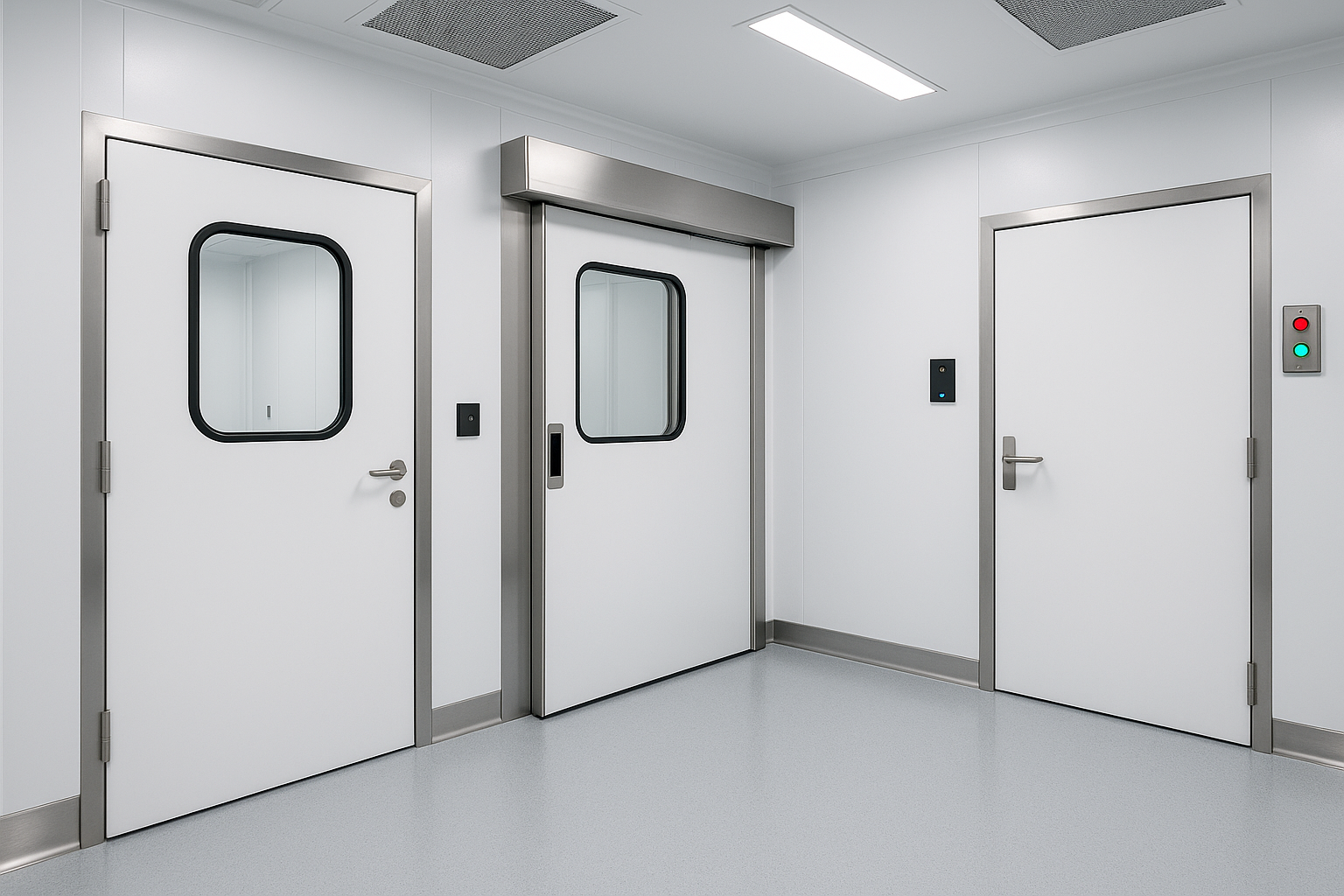
Swing doors are the common cleanroom door type for personnel access points with low-to-moderate traffic frequency. They operate on concealed or surface-mounted hinges and typically incorporate perimeter compression seals and automatic door closers to ensure the door returns to a fully sealed position after each use. Cleanroom swing doors are effective when paired with an airlock or anteroom, because even a well-sealed swing door creates a brief pressure disturbance as it moves through its arc. Single-action doors are standard; double-swing (bidirectional) versions are available for high-traffic corridors where personnel movement is bidirectional.
Sliding Doors
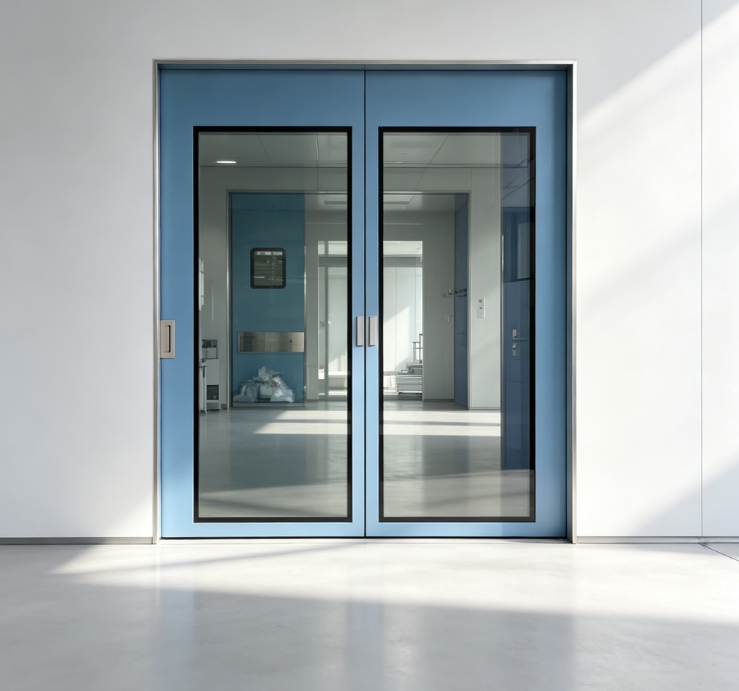
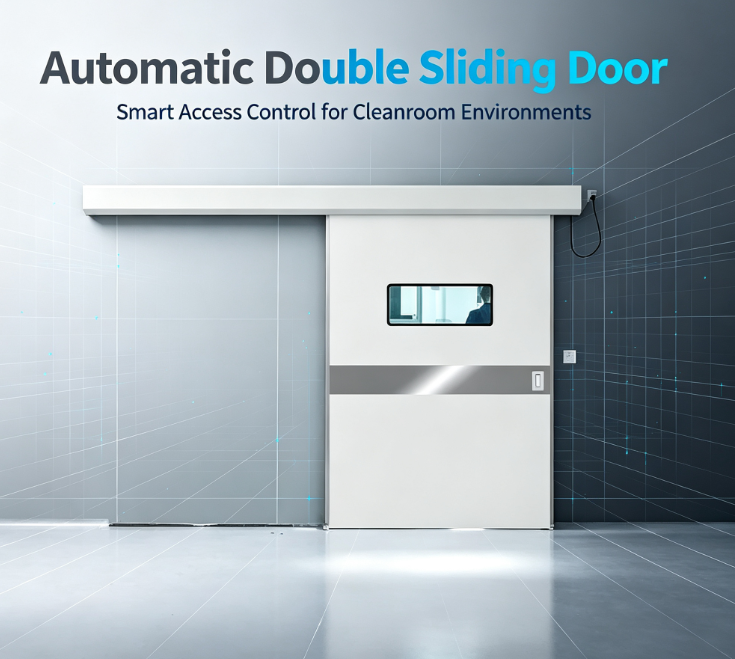
Sliding cleanroom doors move parallel to the wall surface rather than swinging into the room, which eliminates the air displacement caused by a swinging door panel. This makes them preferable in high-ISO-class environments where even momentary airflow disruption is undesirable. Sliding doors are also preferred where floor space is constrained on either side of the opening — common in tightly planned pharmaceutical manufacturing layouts. The primary sealing challenge with sliding doors is the bottom seal: a drop-seal mechanism (where a gasket descends to contact the floor threshold when the door is closed) is the standard solution. Automatic sliding versions reduce manual contact with door surfaces, decreasing bioburden contribution from operators.
High-Speed Roll-Up Doors
High-speed roll-up doors (also called rapid roll doors or fast-action doors) are used at material transfer points where forklift access, pallet movement, or frequent large-opening events are required — typically in lower-classification cleanrooms (ISO 7–8) or in the transition zones between controlled and uncontrolled areas. Their key advantage is cycle speed: opening and closing in less than 1–2 seconds minimizes the duration of the uncontrolled opening event. They are not suitable as primary sealing doors for high-classification spaces because their flexible curtain construction does not provide the airtight seal achievable with rigid door panels and compression gaskets.
Airtight and Hermetically Sealed Doors
Hermetically sealed doors are the highest-specification cleanroom door type, used in ISO 5 and above cleanrooms, biological safety cabinets, operating theaters, and nuclear or BSL-3/4 containment facilities. They feature full-perimeter inflatable seals (pneumatically pressurized gaskets that expand to fill any gap between door panel and frame) that engage automatically when the door closes, achieving leak rates below 1 m³/h at design pressure differentials. Some designs incorporate a secondary pressure-equalizing valve to prevent the inflatable seal from being damaged by excessive differential pressure during opening. These doors are significantly heavier and more mechanically complex than standard cleanroom swing doors and require regular seal inspection and replacement on a defined maintenance schedule.
Interlock (Airlock) Door Systems
An interlock system is not a single door type but a control system that governs two or more cleanroom doors in sequence, ensuring that only one door in a series can be open at any given time. This prevents direct air communication between the cleanroom and the external environment by maintaining a buffer zone (anteroom or airlock) between them. Interlock systems are mandatory in many pharmaceutical GMP environments and are standard practice for ISO 6 and above cleanrooms. They typically use magnetic locks, electronic latch release, and indicator lights controlled by a PLC that monitors door position sensors.
| Door Type | ISO Class Suitability | Best Application | Key Limitation |
|---|---|---|---|
| Swing (Hinged) | ISO 6–9 | Personnel access, low–medium traffic | Air displacement on opening |
| Sliding | ISO 5–8 | Space-constrained layouts, high classification | Bottom seal complexity |
| High-Speed Roll-Up | ISO 7–9 | Material/forklift transfer, high-frequency use | Not airtight; no pressure seal |
| Hermetically Sealed | ISO 3–6 / BSL / OR | Critical containment, operating theaters | High cost; maintenance-intensive |
| Interlock System | ISO 5–8 (as system) | Airlock / anteroom entry sequences | Slows personnel throughput |
Cleanroom Door Materials: What the Door Is Made From Matters
The material composition of a cleanroom door determines its particle shedding behavior, chemical resistance, cleanability, and long-term durability in a sanitized environment. Standard construction materials used in commercial doors — hollow steel with painted surfaces, wood composites, or vinyl-wrapped panels — are unsuitable because their surface finishes degrade under repeated chemical cleaning, generating particles and harboring microbial growth in surface imperfections.
Stainless Steel
316L stainless steel is the premium material for cleanroom doors in pharmaceutical, food processing, and biotechnology environments where frequent chemical cleaning with hydrogen peroxide, chlorine-based disinfectants, or isopropanol is required. Its passive oxide layer resists corrosion from virtually all cleaning agents used in GMP facilities, its smooth surface (typically electropolished to Ra ≤ 0.5 µm) does not harbor bacteria in surface pores, and it generates no particulate shedding under normal use. Stainless steel doors are heavy — a standard 900 × 2100 mm door panel may weigh 60–90 kg — and require robust hinge systems and door closers rated for their mass.
Powder-Coated or Epoxy-Coated Steel
Cold-rolled steel with an electrostatic powder coat or epoxy finish is the widely used material for cleanroom doors in ISO 7–9 environments where the chemical exposure is less aggressive and cost constraints are significant. The coating provides a smooth, hard, cleanable surface that resists moderate concentrations of cleaning agents. The key limitation is coating integrity: chipping, scratching, or delamination of the coating creates particle-generating sites and potential corrosion initiation. Doors in high-traffic corridors require impact protection rails or bumpers to prevent surface damage from equipment collisions.
Aluminum and Aluminum Composite
Aluminum-framed doors with aluminum honeycomb or foam core panels offer a lightweight alternative to steel — typically 30–50% lighter than equivalent steel construction — without sacrificing surface cleanability. Anodized aluminum surfaces resist cleanroom cleaning agents and provide a particle-free surface. Aluminum is the preferred material for sliding cleanroom doors where door weight directly affects the smoothness and reliability of the sliding mechanism. It is not suitable for environments where strong alkaline cleaning agents (pH > 12) are used, as these attack the anodized layer.
GRP (Glass-Reinforced Polymer) and Composite Panels
GRP and similar composite door panels are used in environments where both chemical resistance and electrical non-conductivity are required — such as in semiconductor fabs where ESD control is critical, or in facilities where metal contamination of the product is a concern. GRP panels are inherently non-corrosive, lightweight, and can be manufactured with gel-coat surfaces in any color for zone identification. Their main disadvantage is lower impact resistance compared to steel, making them unsuitable for material transfer doors subject to collision from equipment.
Sealing Systems: The Detail That Determines Cleanroom Door Performance
A cleanroom door panel made from the material will fail to maintain its ISO classification if the sealing system is inadequate. The seal between the door panel and its frame — and between the door bottom and the floor — is where the majority of contamination infiltration occurs in poorly specified installations.
Perimeter Compression Seals
Perimeter seals are continuous gaskets fitted around the door frame that compress against the door panel face or edge when the door is fully closed. The effective designs use silicone or EPDM bubble gaskets — closed-cell elastomers that compress evenly under door contact pressure without taking a permanent set over time. Silicone is preferred in pharmaceutical environments for its resistance to cleaning chemicals and its compliance with FDA 21 CFR food contact regulations. The gasket compression must be calibrated to the door closer force: insufficient compression leaves gaps; excessive compression accelerates gasket wear and increases the force required to close the door.
Automatic Drop-Down Bottom Seals
The gap between door bottom and floor is the difficult sealing point. A fixed brush seal or rubber wiper is impractical for cleanrooms because it contacts the floor surface continuously, generating particles and degrading rapidly from friction. The solution is an automatic drop-down seal: a spring-loaded or lever-operated mechanism within the door bottom that lowers a silicone or neoprene bar to contact the floor threshold only when the door reaches the fully closed position, then retracts automatically as the door begins to open. This eliminates floor contact during door travel while providing a complete seal when closed. Drop-down seals are the standard specification for pharmaceutical and semiconductor cleanroom swing doors.
Inflatable Seals for Hermetic Applications
As noted in the door type section, hermetically sealed doors use inflatable gaskets that are pneumatically pressurized after the door closes. These seals can achieve leakage rates below 0.5 m³/h at 50 Pa differential pressure — far exceeding what is achievable with passive compression gaskets. The inflation system requires a compressed air supply to the door and a control sequence that inflates the seal after closure confirmation and deflates it before the door can open. Seal inspection should include pressure decay testing at regular maintenance intervals to detect gasket fatigue or damage.
Vision Panels in Cleanroom Doors: Requirements and Options
Most cleanroom doors incorporate a vision panel — a glazed window — to allow visual communication between spaces and prevent collision injuries at high-traffic doorways. The vision panel specification must match the overall door's cleanroom performance requirements.
- Glazing material: Toughened (tempered) safety glass is standard. Laminated glass is used where fragment containment is critical (pharmaceutical aseptic filling areas). Polycarbonate is an alternative for impact-resistance-critical applications but scratches more easily and requires replacement when surface clarity degrades.
- Frame design: The vision panel frame must be flush with the door face surface — no recessed edges or shadow gaps — to prevent particle accumulation and facilitate cleaning. Frameless (structural silicone-bonded) glazing achieves the smoothest cleanable surface.
- Thermal considerations: In controlled-temperature cleanrooms, the vision panel represents a thermal bridge. Double-glazed panels with a hermetically sealed argon or dry-air cavity are specified where temperature or humidity differentials across the door are significant.
- UV-blocking glazing: In facilities where UV-sensitive products (certain pharmaceutical compounds, photoresists in semiconductor fabs) are processed, vision panels can be specified with UV-absorbing glass or film to prevent product degradation if the door is adjacent to a production area.
Hardware and Accessories: Every Component Must Be Cleanroom-Compatible
Door hardware — hinges, closers, handles, locks, and kick plates — is a frequently overlooked contamination source. Standard commercial hardware uses lubricants, painted surfaces, and materials that are incompatible with cleanroom cleaning protocols.
Hinges
Concealed hinges are preferred for cleanroom doors because they eliminate the exposed hinge knuckle — a particle trap that is difficult to clean and continuously sheds lubricant aerosols during door operation. Where surface-mounted hinges are used, stainless steel continuous (piano) hinges that run the full height of the door are preferable to point-contact butt hinges, as they distribute load more evenly and have fewer lubricant-containing pivot points.
Door Closers
An overhead door closer is mandatory on all cleanroom swing doors to ensure the door returns to the fully sealed position after each use. Concealed overhead closers (mortised into the door frame or top rail) are cleaner than surface-mounted hydraulic arm closers, which expose hydraulic fluid-containing components to the cleanroom environment. Closing force and speed must be set to ensure complete seal engagement without slamming — which would generate vibration and particle disturbance. EN 2–4 closing force rating is typical for standard cleanroom personnel doors.
Handles and Push Plates
Lever handles in 316 stainless steel or electrolytically polished aluminum are standard for pharmaceutical cleanrooms. Tubular lever handles with no exposed fasteners on the cleanroom face are preferred — screw heads and recesses accumulate contamination and are difficult to clean thoroughly. Hands-free kick plates or elbow-operated push bars reduce manual contact with door surfaces and are specified in aseptic areas and BSL facilities.
Access Control Integration
Cleanroom doors commonly incorporate electronic access control — proximity card readers, keypads, or biometric readers — integrated into the door frame or adjacent wall panel. In cleanroom installations, these devices must be flush-mounted with sealed bezels to prevent particle accumulation around the mounting aperture and must be constructed from materials compatible with cleanroom surface disinfection protocols. Card readers with recessed slots are unsuitable — contactless readers with flat, sealed faces are the correct specification.
Cleanroom Door Standards and Regulatory Compliance
Cleanroom doors must comply with both cleanroom-specific standards and applicable building and fire safety regulations. These requirements sometimes conflict — fire door requirements may mandate materials or gap tolerances that compromise cleanroom sealing performance — and the engineer must navigate these trade-offs in the design phase.
| Standard / Regulation | Issuing Body | Relevance to Cleanroom Doors |
|---|---|---|
| ISO 14644-1 / -4 | ISO | Cleanroom classification and design requirements including envelope integrity |
| EU GMP Annex 1 (2022) | EMA / European Commission | Sterile manufacturing facility design; airlock and pressure cascade requirements |
| FDA 21 CFR Part 211 | FDA (USA) | GMP facility design requirements for pharmaceutical manufacturing |
| EN 1634 (Fire Door Testing) | CEN (Europe) | Fire resistance rating for cleanroom doors that also serve as fire barriers |
| NFPA 101 / IBC | NFPA / ICC (USA) | Life safety egress requirements applicable to all facility doors including cleanrooms |
| IEST-RP-CC012 | IEST (USA) | Recommended practices for cleanroom construction including envelope components |
Fire Door and Cleanroom Door: Reconciling Conflicting Requirements
When a cleanroom door is also required to function as a fire door (FD30, FD60, etc.), the design must satisfy both cleanroom sealing performance and fire resistance certification simultaneously. Standard intumescent fire seals — which expand when exposed to heat — are not cleanroom-compatible in their conventional form because they create recessed channels around the door frame that trap particles. Specialist fire door manufacturers have developed flush-profile intumescent strips integrated within the door frame rebate that meet both EN 1634 fire resistance requirements and ISO 14644-4 cleanroom surface standards. These should be specified explicitly — not assumed to be available from standard fire door suppliers.
Cleanroom Door Selection by ISO Classification
The appropriate door specification escalates with ISO classification strictness. Over-specifying a door (installing a hermetically sealed door in an ISO 8 environment) wastes capital unnecessarily; under-specifying risks classification failure and contamination events.
- ISO 8 (Class 100,000): Powder-coated steel swing door with perimeter compression seal, automatic closer, and drop-down bottom seal. Vision panel with flush frame. Standard for support areas in pharmaceutical facilities, hospital corridors, and food manufacturing.
- ISO 7 (Class 10,000): As ISO 8, but with enhanced seal specification, stainless steel hardware, and interlocked airlock entry system. Common in pharmaceutical secondary manufacturing and medical device assembly.
- ISO 6 (Class 1,000): 316L stainless steel or high-grade aluminum sliding or swing door with full perimeter compression seal, automatic drop seal, and interlock control. Access control integration standard.
- ISO 5 (Class 100): Hermetically sealed or high-specification sliding door with inflatable perimeter seal. Full interlock airlock with pressure cascade. Stainless steel construction throughout. Used in pharmaceutical aseptic filling, semiconductor lithography areas.
- ISO 3–4 and BSL-3/4: Fully hermetic doors with inflatable seals, pressure monitoring, and interlocked entry/exit sequences. All hardware concealed and flush. Specialist manufacturers only — not available from standard cleanroom door suppliers.
Installation, Qualification, and Ongoing Maintenance
Even a correctly specified cleanroom door will fail its function if installed or maintained improperly. Installation quality and ongoing seal integrity are as critical as the initial specification.
Installation Requirements
Cleanroom doors must be installed after all wet trades (plastering, screeding, painting) are complete and the room has been cleaned to at least the classification level required. Installing a door into a construction-dust-laden environment and subsequently attempting to clean to ISO standards is a common and avoidable error. The door frame must be set plumb, level, and square to within ± 1 mm over the full frame height — any racking causes uneven seal compression and gaps at frame corners.
Qualification Testing
As part of cleanroom commissioning and qualification (IQ/OQ/PQ), each door should be subject to:
- Pressure differential verification: Confirming that the room maintains its design differential pressure (e.g., +12.5 Pa) with the door closed, using a calibrated magnehelic gauge or pressure transmitter.
- Seal integrity check: Using a smoke pencil or tracer gas (e.g., SF6 with an appropriate detector) around the door perimeter to identify any leakage pathways through seals or frame junctions.
- Closer force and speed: Verifying that door closing speed and latch engagement force meet design specifications, confirmed with a door closer speed test device.
- Interlock function testing: Confirming that the interlock system prevents simultaneous opening of both doors in a sequence, and that fail-safe lock engagement occurs on power loss.
Ongoing Maintenance Schedule
Cleanroom door maintenance is a documented, scheduled activity — not a reactive response to visible damage. A typical maintenance program includes:
- Monthly: Visual inspection of perimeter and bottom seals for compression set, cracking, or deformation. Verification of door closer function. Check for surface damage or coating deterioration.
- Quarterly: Pressure differential verification across each door. Lubrication of concealed hinge mechanisms with cleanroom-compatible lubricant (dry PTFE or silicone-based). Interlock system function test.
- Annually: Full seal replacement for high-frequency doors (those cycled more than 50 times per day). Smoke test of all door perimeter seals. Review of door closer force settings against original qualification data. For hermetically sealed doors: inflatable seal pressure decay test and replacement if leakage rate exceeds specification.