English
 русский
 Español
Content
- 1 What Is a Pass Through Box and Why Does the Cleaning Type Matter?
- 2 How a Non-Self-Cleaning Pass Through Box Works
- 3 How a Self-Cleaning Pass Through Box Works
- 4 Direct Comparison: Key Differences Between Both Types
- 5 Applicable Scenarios for Non-Self-Cleaning Pass Through Boxes
- 6 Applicable Scenarios for Self-Cleaning Pass Through Boxes
- 7 Selection Decision Framework: Choosing the Right Type for Your Facility
What Is a Pass Through Box and Why Does the Cleaning Type Matter?
A pass through box — also called a pass through chamber or transfer hatch — is a controlled-access enclosure installed in the wall between two rooms of different cleanliness classifications. Its purpose is to enable the transfer of materials, components, tools, or documents between these environments without requiring personnel to physically cross the boundary, thereby preventing the migration of contaminants from a lower-class area into a higher-class cleanroom. Pass through boxes are fundamental infrastructure in pharmaceutical manufacturing, semiconductor fabrication, hospital operating theatre suites, microelectronics assembly, and any other facility where maintaining strict environmental separation is a regulatory or quality requirement.
The distinction between a non-self-cleaning pass through box and a self-cleaning pass through box is one of the most consequential equipment selection decisions in cleanroom design. It determines not only how contamination is managed during transfers but also how much manual cleaning intervention is required, how quickly the transfer cycle can be completed, what level of microbial or particulate risk is introduced at each transfer event, and ultimately which regulatory standards the facility can credibly claim to meet. Understanding the mechanical, operational, and compliance differences between these two types is essential before specifying either for a new facility or a cleanroom upgrade project.
How a Non-Self-Cleaning Pass Through Box Works
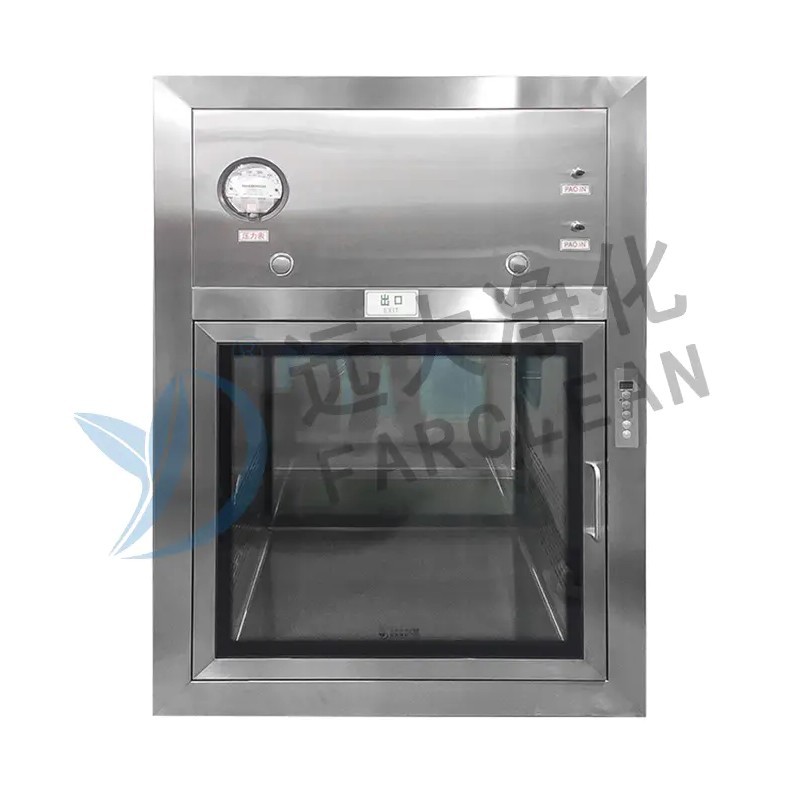
A non-self-cleaning pass through box is a passive transfer device. In its most basic form, it consists of a stainless steel chamber with interlocked doors on each side — one opening into the lower-classification room and one into the higher-classification cleanroom — a UV germicidal lamp for surface decontamination between transfers, and in many configurations, a HEPA filtration unit that maintains positive pressure within the chamber to prevent inward contamination migration when either door is opened.
The term "non-self-cleaning" refers to the fact that the physical cleaning of the chamber interior — wiping down surfaces with disinfectant, removing particulate matter deposited during transfers, cleaning drainage points — must be performed manually by cleanroom personnel following established standard operating procedures (SOPs). The UV lamp irradiation cycle that occurs between transfers does provide a degree of microbial surface decontamination, but UV radiation does not remove particulate contamination, does not reach shadowed surfaces, and cannot substitute for validated chemical disinfection when bioburden reduction to a specific log reduction level is required.
Non-self-cleaning pass through boxes are manufactured in a wide range of sizes — from small desktop units for document or sample vial transfers to large floor-standing chambers capable of accommodating equipment trolleys. Materials of construction are typically 304 or 316L stainless steel with continuous internal welds, coved internal corners to eliminate particle-trapping recesses, and smooth mirror-polished internal surfaces that minimise adhesion of particles and microorganisms. Interlock mechanisms — either mechanical or electronic — prevent both doors from opening simultaneously, which is a mandatory contamination control feature regardless of the cleaning type.
How a Self-Cleaning Pass Through Box Works
A self-cleaning pass through box incorporates an automated decontamination system within the chamber that operates without manual intervention between transfer cycles. The most common automated decontamination technologies used in self-cleaning pass through boxes are vaporised hydrogen peroxide (VHP), hydrogen peroxide vapour (HPV), or formaldehyde gas — with VHP being the current industry standard due to its efficacy, residue profile, material compatibility, and regulatory acceptance across pharmaceutical and healthcare applications.
In a VHP self-cleaning pass through box, the automated cycle follows a defined sequence: the chamber seals, a vaporiser unit injects H₂O₂ vapour at a controlled concentration (typically 100–1,000 ppm depending on the required log reduction), the vapour dwells within the sealed chamber for a validated contact time, and a catalytic converter or aeration phase then breaks the residual H₂O₂ down to water and oxygen, bringing the residual concentration below the occupational exposure limit (typically 1 ppm) before the clean-side door can be opened. The entire automated cycle typically takes 15 to 45 minutes depending on chamber volume and the required decontamination level — achieving sporicidal activity of ≥6 log reduction against Geobacillus stearothermophilus spores, which is the benchmark for pharmaceutical Grade A/B boundary decontamination.
Some self-cleaning pass through boxes supplement the VHP cycle with an integrated HEPA-filtered airflow system that purges particulate contamination introduced during the loading process, providing both particulate and microbial decontamination in a single automated cycle. Control systems on self-cleaning units are typically PLC-based with touchscreen interfaces, cycle logging, alarm management, and data export capability for electronic batch record integration — features that directly support 21 CFR Part 11 compliance in FDA-regulated pharmaceutical facilities.
Direct Comparison: Key Differences Between Both Types
The operational, performance, and cost differences between non-self-cleaning and self-cleaning pass through boxes are substantial. The following table provides a structured comparison across the criteria most relevant to cleanroom specification decisions:
| Criteria | Non-Self-Cleaning Pass Through Box | Self-Cleaning Pass Through Box |
|---|---|---|
| Decontamination Method | Manual wipe-down + UV irradiation | Automated VHP / HPV gas cycle |
| Sporicidal Efficacy | Limited (UV surface only, no spore kill) | ≥6 log reduction (validated sporicidal) |
| Personnel Intervention Required | Yes — manual cleaning per SOP | No — fully automated cycle |
| Transfer Cycle Time | Short (2–10 min including UV) | Longer (15–45 min for full VHP cycle) |
| Capital Cost | Lower | Significantly higher |
| Operational Cost | Higher (labour, disinfectant, SOP management) | Lower per cycle (automated consumables only) |
| Process Validation | Cleaning SOP validation required | Cycle validation with BI indicators |
| Applicable Cleanroom Grade | Grade C/D to Grade B (EU GMP) with controls | Grade A/B boundary; ISO Class 5 and above |
| Data Logging and Traceability | Manual records only | Automated electronic batch records |
Applicable Scenarios for Non-Self-Cleaning Pass Through Boxes
Non-self-cleaning pass through boxes remain the appropriate and cost-effective solution across a broad range of cleanroom and controlled-environment applications where the contamination risk profile does not demand automated sporicidal decontamination and where manual cleaning procedures can be reliably validated and consistently executed.
Grade C to Grade D Pharmaceutical Manufacturing Boundaries
In pharmaceutical facilities, transfers between Grade D packaging areas and Grade C secondary processing areas do not require sporicidal treatment at the transfer point. A non-self-cleaning pass through box with UV lamp, HEPA-filtered positive pressure, and a validated manual wipe-down SOP using an appropriate sporicide or disinfectant provides a compliant contamination control measure at this boundary type. The lower capital cost and simpler validation requirements of the non-self-cleaning unit make it the standard specification for these less critical internal boundaries.
Hospital and Healthcare Environments
In hospital pharmacy compounding rooms, isolation ward supply corridors, and central sterile services departments, non-self-cleaning pass through boxes serve as the primary material transfer mechanism between clean and dirty zones. The transfer frequency and material types in these environments — packaged medications, wrapped sterile instruments, specimen containers — are compatible with UV-assisted manual cleaning protocols, and the simpler operating requirements suit healthcare staff with general rather than specialist cleanroom training.
Electronics and Semiconductor Assembly
In ISO Class 6 and 7 electronics cleanrooms handling printed circuit board assembly, optical component manufacturing, or precision instrument production, the primary contamination concern is particulate rather than microbial. Non-self-cleaning pass through boxes equipped with HEPA-filtered air purge systems and ionisation bars (to neutralise electrostatic charges that attract particles to component surfaces) provide adequate contamination control at these boundaries without the complexity or cost of automated chemical decontamination systems.
Applicable Scenarios for Self-Cleaning Pass Through Boxes
Self-cleaning pass through boxes with automated VHP decontamination are specified wherever the consequence of a contamination event is severe — in terms of patient safety, product sterility assurance, regulatory compliance, or the integrity of sensitive research or manufacturing processes.
Sterile Drug Product Manufacturing — Grade A/B Boundaries
The most critical and demanding application for self-cleaning pass through boxes is at the boundary between Grade B background cleanrooms and Grade A filling zones in sterile pharmaceutical manufacturing. EU GMP Annex 1 (2022 revision) explicitly addresses the need for robust contamination control measures at material transfer points into Grade A environments, and automated VHP pass through boxes have become the industry-standard engineering control at this boundary. The validated sporicidal cycle provides documented and reproducible decontamination evidence that manual cleaning cannot reliably match, and the electronic data logging supports the Contamination Control Strategy (CCS) documentation now required by the revised Annex 1.
Biosafety Level 3 and BSL-4 Containment Laboratories
Research facilities handling Select Agents, Category A pathogens, or high-consequence biological materials at BSL-3 and BSL-4 containment levels require that any material exiting the containment zone undergo validated decontamination before entering the surrounding environment. Self-cleaning pass through boxes with automated VHP cycles are a primary engineering control at these facility boundaries, providing an auditable, automated decontamination step that does not require personnel to enter the high-hazard zone to perform manual cleaning.
Advanced Therapy Medicinal Product (ATMP) Facilities
Cell and gene therapy manufacturing facilities handling autologous or allogeneic cell products have extremely stringent cross-contamination prevention requirements — where a contamination event between two patient-specific products could have direct and serious patient safety consequences. Self-cleaning pass through boxes with automated decontamination cycles and full electronic traceability are the specification standard for material transfers into and out of the individual patient product suites in these facilities, providing a validated contamination break between each product campaign.
Selection Decision Framework: Choosing the Right Type for Your Facility
The choice between non-self-cleaning and self-cleaning pass through boxes should be driven by a structured risk assessment rather than cost alone. The following criteria provide a practical decision framework:
- Define the contamination consequence at the transfer boundary. If a contamination event at this point could result in a non-sterile product reaching a patient, a clinical trial failure, or a regulatory action, a self-cleaning unit with validated sporicidal efficacy is warranted. If the consequence is limited to rework or batch rejection without patient safety impact, a non-self-cleaning unit with a robust manual SOP may be sufficient.
- Evaluate transfer frequency and throughput requirements. Self-cleaning VHP cycles of 15–45 minutes limit transfer frequency. If your process requires frequent, rapid material transfers, either multiple self-cleaning units in parallel or a non-self-cleaning unit with a fast UV-assisted cycle may be operationally necessary.
- Assess the reliability of manual cleaning in your operating environment. Non-self-cleaning units depend entirely on operator compliance and SOP adherence. In facilities with high staff turnover, multiple shift patterns, or inadequate SOP training infrastructure, the human dependency of manual cleaning introduces variability that automated self-cleaning systems eliminate.
- Consider material compatibility with VHP. Not all materials tolerate repeated VHP exposure — some metals, certain polymers, and electronic components may be degraded by oxidative H₂O₂ vapour over time. If items being transferred include VHP-sensitive materials, a non-self-cleaning unit with an appropriate alternative disinfection protocol may be necessary.
- Factor in total lifecycle cost, not only capital expenditure. A self-cleaning unit's higher purchase price is frequently offset over a three-to-five-year period by reduced labour costs, lower disinfectant consumption, and avoided contamination events — which in pharmaceutical environments can each carry remediation, batch rejection, and regulatory investigation costs far exceeding the cost of the equipment itself.
In summary, non-self-cleaning pass through boxes deliver reliable contamination control at lower-risk internal boundaries where manual process discipline is maintained and the contamination risk profile is manageable. Self-cleaning pass through boxes with automated VHP decontamination are the appropriate engineering control wherever a validated, personnel-independent, and electronically traceable sporicidal transfer process is required by regulatory expectations, risk assessment outcomes, or the critical nature of the products being manufactured or handled.