English
 русский
 Español
Content
- 1
- 2 What are the key considerations for cleanroom design in pharmaceutical production?
- 3 How do modular cleanroom partitions affect flexibility in pharmaceutical facilities?
- 4 Why does material choice influence cleanroom performance?
- 5 How does airflow management contribute to cleanroom safety?
- 6 Can modular cleanrooms support different pharmaceutical processes?
- 7 What role does installation and maintenance play in cleanroom selection?
- 8 How do cost and sustainability influence cleanroom decisions?
- 9 Are there industry trends shaping cleanroom development?
What are the key considerations for cleanroom design in pharmaceutical production?
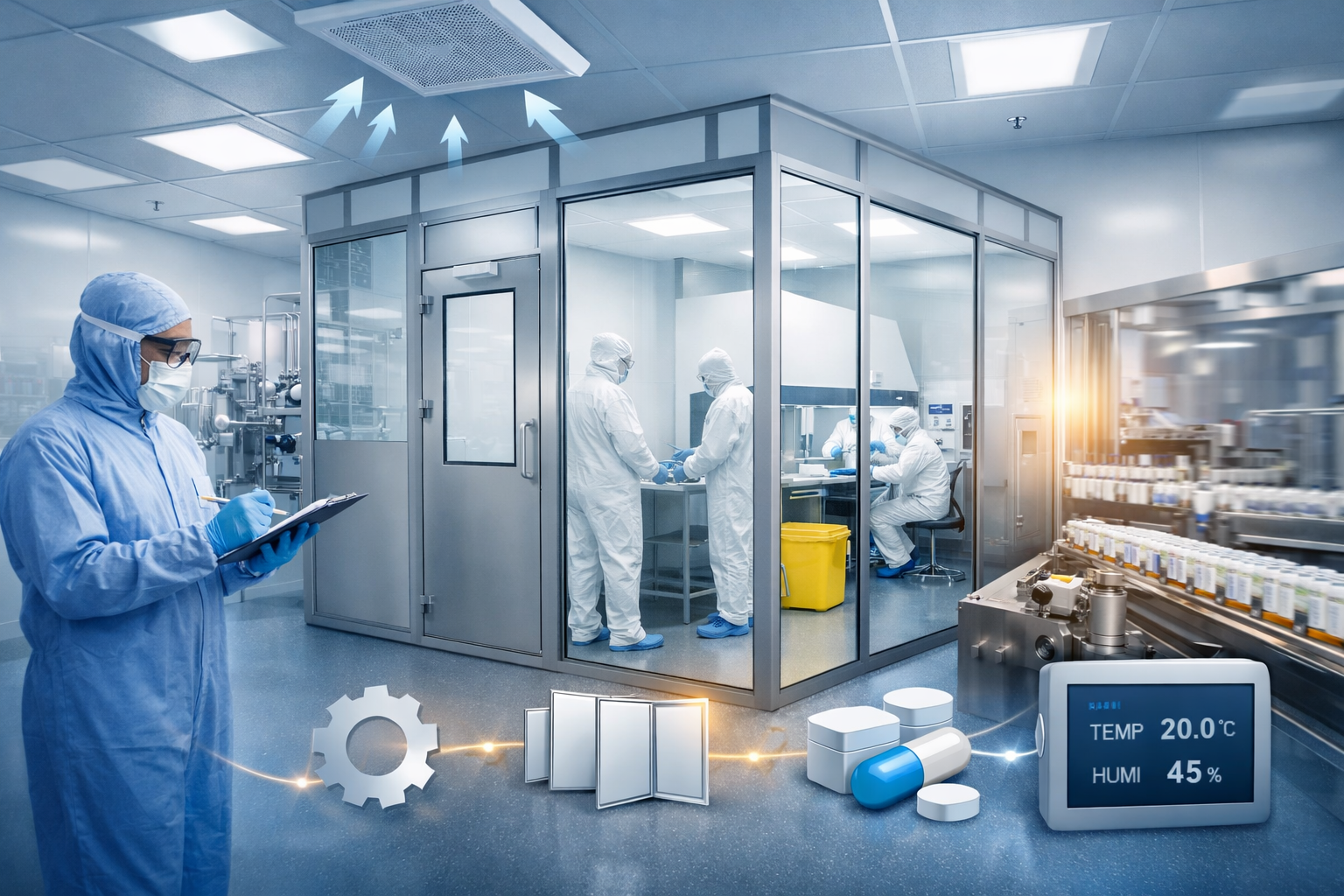
Pharmaceutical manufacturing depends on tightly controlled environments to protect product integrity and ensure patient safety. Cleanrooms serve as the foundation for this control by managing air quality, personnel flow, and potential contamination sources. When designing cleanrooms for pharmaceutical production, the following key considerations are important:
1. Contamination Control
- Airborne particles: It is critical to maintain very low particle counts through effective air filtration and directed airflow patterns that remove contaminants from sensitive zones.
- Surface cleanliness: Smooth, non-porous surfaces on walls, ceilings, and floors help prevent particle buildup and support thorough, routine cleaning.
- Cross-contamination prevention: Proper zoning and physical separation between process areas minimize the risk of contaminants transferring from one stage of production to another.
2. Material Selection
- Durability and chemical resistance: Walls, partitions, and doors must be made from materials that can withstand repeated cleaning with disinfectants without degrading or generating particles.
- Ease of maintenance: Materials should be selected for their ability to be cleaned and repaired easily, which helps reduce operational interruptions and costs.
- Lightweight and flexible options: Modular or adaptable materials can provide flexibility when future layout changes or expansions are anticipated.
3. Layout and Workflow
- Optimized staff movement: Logical pathways and minimized unnecessary traffic help limit the introduction and spread of contaminants by personnel.
- Segregation of zones: Clear divisions between areas with different cleanliness requirements—such as sterile production versus packaging—prevent cross-contamination.
- Accessibility for cleaning: All surfaces and equipment must be designed so that staff can reach and sanitize every area effectively.
4. Airflow and Environmental Control
- Air changes per hour: Adequate rates of filtered air exchange are needed to continuously dilute and remove airborne particles.
- Pressure differentials: Maintaining the right pressure gradients between adjacent zones ensures that air moves from cleaner areas to less clean ones, blocking contaminant ingress.
- Temperature and humidity management: Consistent control of temperature and humidity is necessary to maintain product stability and reliable manufacturing conditions.
5. Human Factors
- Staff ergonomics: Workstations and layouts should be arranged to support comfortable, efficient operation and reduce physical fatigue for personnel.
- Behavioral protocols: The design should make it easier for staff to adhere to gowning, material handling, cleaning, and movement procedures without confusion.
- Training compatibility: Cleanroom features should align with training efforts, helping personnel understand and follow practices consistently.
6. Maintenance and Operational Efficiency
- Ease of cleaning: Surfaces and systems should allow for straightforward, frequent sanitation using standard methods.
- Longevity of components: High-quality ceilings, walls, doors, and partitions contribute to longer service intervals and lower replacement needs.
- Flexibility for upgrades: The overall design should permit modifications for new equipment or changing regulatory requirements with minimal major reconstruction.
Integrating these considerations thoughtfully results in cleanrooms that deliver strong contamination control while supporting efficient, compliant, and adaptable pharmaceutical production operations.
How do modular cleanroom partitions affect flexibility in pharmaceutical facilities?
In pharmaceutical manufacturing, the ability to adapt quickly to changing production needs, process updates, and new regulatory requirements is very important. Modular cleanroom partitions provide a clear advantage over traditional fixed-wall construction. They allow walls, partitions, and ceilings to be reconfigured or expanded with relatively little disruption to daily operations.
1. Rapid Reconfiguration for Changing Needs
- Modular partitions can be repositioned or adjusted in a shorter timeframe to suit new production requirements.
- When airflow patterns need modification or extra space is required, modular walls can often be changed without major construction work.
- This approach helps reduce downtime and keeps the facility running during process transitions.
2. Supporting Multi-Product Facilities
- Facilities that manufacture multiple products benefit from the flexibility of modular systems.
- Partitions allow effective separation between zones, for example by isolating sterile production areas from packaging zones, which helps minimize cross-contamination risks.
- Individual modules can be set up to meet different cleanliness levels, enabling several processes to run safely within the same facility.
3. Simplified Expansion
- As production volumes grow, additional modular sections can be added without the need to remove or rebuild existing walls.
- This avoids large-scale construction projects and supports continued operations during expansion periods.
- Modular systems make it possible to scale up in a more efficient and controlled manner.
4. Maintenance Advantages
- Many modular partitions include removable panels or accessible designs that simplify routine maintenance, inspections, and cleaning.
- Repairs can usually be completed with minimal interruption to production.
- This leads to more predictable maintenance schedules and better overall operational efficiency over time.
5. Optimized Workflow
- Flexible layouts allow facilities to adjust staff movement paths and production flows more easily as needs change.
- Partitions can be rearranged to reduce unnecessary movement between clean zones, helping to lower contamination risks.
- Well-planned modular arrangements also support consistent airflow patterns.
6. Cost Considerations
- Although modular partitions may involve a higher initial cost than traditional fixed walls, they often provide savings in the long term.
- Advantages include reduced downtime during reconfigurations, simpler maintenance, and the ability to expand without expensive major renovations.
- This flexibility enables facilities to respond to market demands or regulatory changes with less disruption and lower overall expense.
7. Comparison of Modular vs. Fixed-Wall Cleanrooms
| Feature | Modular Partitions | Fixed Walls |
|---|---|---|
| Adaptability | High | Low |
| Installation Time | Short | Long |
| Maintenance Ease | Easy | Moderate |
| Workflow Flexibility | High | Low |
| Cost of Modification | Moderate | High |
This comparison highlights that modular cleanroom partitions generally offer adaptability, faster installation, and easier modifications. While initial costs may vary, the long-term gains in efficiency and flexibility often make modular systems a practical option for pharmaceutical facilities that must stay responsive while upholding strong contamination control.
Why does material choice influence cleanroom performance?
In pharmaceutical cleanroom design, the choice of materials goes beyond basic structure. Materials directly affect contamination control, safety, maintenance demands, and overall operational efficiency. Selecting the right materials requires balancing performance, practicality, and long-term needs.
1. Surface Smoothness and Contamination Control
- Smooth, non-porous surfaces play a key role in reducing particle buildup. They limit the settling of dust, microbes, and chemical residues.
- Floors, walls, and ceilings made with these surfaces help lower the risk of cross-contamination during manufacturing.
- Easy-to-clean materials support regular sanitation procedures without causing damage to the surfaces themselves.
2. Chemical Resistance and Durability
- Cleanrooms are frequently exposed to strong disinfectants and cleaning agents. Materials must withstand corrosion, warping, or discoloration over time.
- Durable materials extend the service life of walls, partitions, and ceilings, which reduces the need for frequent replacements and lowers maintenance costs.
- Combining chemical-resistant finishes with robust structural elements helps ensure the cleanroom remains dependable under continuous use.
3. Installation Efficiency
- Certain materials are specifically designed for modular or quick assembly, which simplifies the installation process and shortens downtime.
- Lightweight panels and wall systems can often be installed rapidly without requiring heavy equipment, speeding up initial setup or later modifications.
- Easy installation also makes it simpler to replace individual damaged sections, keeping production interruptions to a minimum.
4. Environmental and Sustainability Considerations
- Lightweight materials decrease the overall load on the building structure, which can reduce construction costs and make future expansions easier.
- Choosing recyclable or reusable components supports corporate sustainability objectives and helps limit environmental impact.
- Facilities can select materials that combine strong operational performance with more eco-friendly properties to align with broader environmental goals.
5. Examples of Material Applications
- Walls: Smooth, coated panels help prevent particle accumulation and hold up well under repeated chemical cleaning.
- Ceilings: Lightweight, modular ceiling tiles provide easy access for HVAC maintenance while supporting effective airflow.
- Floors: Anti-static, chemical-resistant flooring maintains hygiene standards and can handle the weight of heavy equipment.
- Partitions: Reconfigurable panels allow adaptation to changing processes while still providing reliable contamination barriers.
6. Balancing Performance Factors
When choosing materials for pharmaceutical cleanrooms, facilities typically consider several key priorities together:
- Cleanliness: Surfaces that minimize particle retention and are easy to sanitize.
- Durability: Strong resistance to wear, chemicals, and frequent cleaning cycles.
- Flexibility: The ability to support future process changes or facility expansion.
- Sustainability: Materials that reduce long-term environmental impact where possible.
7. The Impact on Operational Efficiency
- Suitable materials can reduce the time and effort needed for cleaning, allowing staff to focus more on production activities.
- High-quality materials to fewer disruptions caused by material degradation or the need for replacements.
- The right material choices also help maintain stable environmental conditions inside the cleanroom, supporting consistent product quality and regulatory compliance.
Careful material selection contributes significantly to a cleanroom's long-term performance, reliability, and adaptability in pharmaceutical manufacturing.
How does airflow management contribute to cleanroom safety?
In pharmaceutical cleanrooms, safety depends on more than just keeping surfaces clean. Airflow management is a core part of contamination control. If ventilation is not handled properly, particles can accumulate even in carefully maintained areas, which can affect both product quality and personnel safety.
1. Controlled Ventilation: Removing Contaminants Efficiently
Airflow systems are designed to steadily carry particles away from sensitive production zones. Several key elements support this:
- Air changes per hour (ACH): Regular replacement of air with filtered supply helps keep contamination levels low.
- Pressure differentials: Maintaining positive pressure in cleaner areas helps stop contaminants from entering from surrounding spaces.
- Filtration systems: HEPA or ULPA filters remove microscopic particles, bacteria, and other airborne matter.
Even minor disruptions to airflow can to stagnant zones where particles settle, reducing the overall cleanliness of the space.
2. Integration with Cleanroom Layout
Airflow does not work independently from the physical layout. The positioning of partitions, doors, and ceiling panels has a direct effect on how air moves through the room:
- Misplaced partitions can create turbulence or areas with poor air circulation.
- A well-organized layout supports smoother airflow, often promoting laminar flow to reduce particle settling.
- During design, many facilities model airflow patterns to identify and resolve potential problem areas before building begins.
One useful way to picture this is to compare airflow to water flowing in a stream. Obstacles in the path can cause swirling spots where debris gathers. In the same way, carefully planned partitions and room features help keep air moving evenly and cleanly across the cleanroom.
3. Energy Efficiency and Operational Benefits
Airflow management supports safety while also influencing costs and efficiency:
- Efficient designs prevent unnecessary over-ventilation, which helps control energy consumption.
- Variable Air Volume (VAV) systems can adjust airflow rates according to real-time conditions and cleanliness demands.
- A balanced approach allows facilities to meet regulatory standards without excessive operating expenses.
4. The Takeaway: Safety, Quality, and Efficiency
Proper airflow management contributes to several key outcomes:
- More consistent and reliable product quality
- Better protection for people working inside the cleanroom
- Improved compliance with industry and regulatory requirements
- Reduced overall operational costs
By addressing airflow planning early — from filter choices and pressure zoning to layout decisions — pharmaceutical facilities can build cleaner, safer, and more efficient cleanrooms.When airflow management is integrated thoughtfully with other design elements, it strengthens the overall performance and reliability of the cleanroom environment.
Can modular cleanrooms support different pharmaceutical processes?
Pharmaceutical manufacturing is a complex field, encompassing a variety of processes that each have distinct requirements. From compounding active ingredients to packaging finished products, every stage demands strict control of environmental factors such as cleanliness, humidity, and temperature. Modular cleanroom systems offer the flexibility to address these varying needs within a single facility.
1. Adapting to Diverse Production Needs
- Different processes require different cleanroom classifications. Sterile drug production often demands stricter contamination control than non-sterile operations.
- Modular cleanrooms allow sections to be tailored for specific processes. This ensures that critical areas maintain appropriate standards without compromising other parts of the facility.
- Temperature and humidity controls can be configured independently for different modules, providing precise environmental conditions where needed.
2. Creating Separate Zones for Cross-Contamination Prevention
- Cross-contamination is a significant concern in multi-product facilities. Modular partitions help create effective physical and airflow separations between zones.
- Packaging, storage, and sterile production areas can be isolated while maintaining convenient workflow.
- Movable or reconfigurable partitions allow zones to be expanded or adapted as production requirements evolve, reducing the risk of contamination during process changes.
3. Customization Without Extensive Renovation
- Traditional construction often requires significant time and expense to modify walls, airflow, or room layout. Modular systems simplify this process.
- Partitions, ceilings, and panels can be repositioned or replaced without shutting down production.
- Regulatory compliance is easier to maintain when cleanroom layouts can be adjusted to meet updated standards or accommodate new processes.
4. Supporting Multi-Product Manufacturing
- Facilities that produce multiple drugs or formulations benefit from modular designs.
- Different modules can operate simultaneously under varying environmental conditions, allowing efficient use of space and resources.
- For example, a compounding module may require moderate air cleanliness, while a sterile filling module demands higher standards. Modular systems provide the flexibility to support both within one facility.
5. Operational Efficiency and Workflow Benefits
- Modular cleanrooms facilitate optimized staff movement, reducing unnecessary traffic between critical zones.
- Workflow can be designed to match the sequence of production processes, lowering the risk of contamination and improving productivity.
- Equipment can be integrated into specific modules without affecting adjacent areas, making process-specific operations more efficient.
6. Scalability for Future Growth
- Production demands can change over time. Modular cleanrooms allow new processes to be introduced with minimal disruption.
- Additional modules can be added, or existing ones reconfigured, to accommodate increased capacity or new products.
- This adaptability ensures that a facility can evolve alongside business needs while maintaining operational efficiency and compliance.
7. Illustrative Table: Process-Specific Modular Cleanroom Applications
| Process Type | Environmental Needs | Modular Adaptation | Benefit |
|---|---|---|---|
| Sterile Production | High cleanliness, strict airflow | Dedicated modules with isolated zones | Ensures contamination control and safety |
| Compounding | Moderate cleanliness, controlled humidity | Flexible partitions for workflow adjustments | Adapts easily to changing production needs |
| Packaging | Lower cleanliness, easier access | Adjustable modules for efficient material handling | Improves material flow and operational efficiency |
| Storage & Testing | Stable temperature, moderate cleanliness | Reconfigurable spaces for equipment placement | Optimizes space utilization and flexibility |
The table highlights how modular systems provide targeted solutions for different production requirements. By allowing customization without major construction, modular cleanrooms make facilities more versatile and future-proof.
What role does installation and maintenance play in cleanroom selection?
In pharmaceutical cleanroom projects, installation and maintenance are important factors that are sometimes underestimated when choosing a system. In practice, they have a significant effect on how efficiently, safely, and cost-effectively the cleanroom operates throughout its lifetime. A system that is hard to install or difficult to maintain can cause repeated interruptions and reduce the effectiveness of contamination control.
1. Importance of Efficient Installation
- Minimizing downtime: Facilities frequently need to maintain production during upgrades or expansions. Cleanroom systems that install quickly with little interference help keep operations running smoothly.
- Modular vs. traditional systems: Modular cleanrooms generally allow faster installation than conventional construction methods, since panels, ceilings, and partitions can be assembled without heavy machinery.
- Reduced labor and logistical complexity: Designs that make assembly straightforward reduce the number of personnel needed on site and help prevent installation mistakes.
2. Maintenance as a Key Factor
- Ease of cleaning: Smooth, non-porous, and chemically resistant surfaces simplify routine sanitation. This reduces labor time and helps maintain lower contamination risks.
- Durable materials: Long-lasting components mean fewer replacements are required, which avoids unnecessary production stops and helps control long-term costs.
- Removable components: Features such as removable panels, ceiling tiles, and partitions make cleaning and maintenance tasks easier and more efficient.
3. Workflow and Accessibility
- Access to critical systems: A good design allows straightforward access to HVAC units, filters, and structural elements without dismantling large sections of walls or ceilings.
- Workflow planning: Practical layouts and accessible maintenance points enable staff to carry out regular checks and repairs without disrupting ongoing production.
- Reducing contamination risks: Easier access for maintenance lowers the chance that overlooked or hard-to-reach areas will become sources of contamination.
4. Staff Training and Operational Consistency
- Even the advanced cleanroom systems still depend on properly trained staff to maintain the required performance standards.
- Clear procedures for cleaning, inspection, and minor adjustments help personnel consistently meet regulatory requirements.
- Modular and user-friendly designs make training simpler because routine operations and maintenance tasks are more intuitive.
5. Long-Term Benefits
- Facilities that select systems with simple installation and low-maintenance features usually face fewer operational interruptions.
- Faster installation allows new cleanrooms or expansions to become productive sooner, supporting production schedules.
- Efficient maintenance helps lower ongoing costs, supports regulatory compliance, and extends the usable life of the cleanroom.
6. Illustrative Table: Installation and Maintenance Impact
| Feature | Benefit of Efficient Design | Potential Risk if Neglected |
|---|---|---|
| Quick Installation | Minimizes downtime and speeds start-up | Prolonged disruption and delayed production |
| Easy-to-clean Surfaces | Reduces labor costs and contamination risk | Build-up of dirt and higher contamination risk |
| Removable Panels/Ceilings | Simplifies inspections and repairs | Difficult maintenance and higher repair costs |
| Staff Training Integration | Ensures consistent performance | Operational errors and contamination issues |
This table shows the real-world advantages of carefully considering installation and maintenance when selecting a cleanroom system. Paying proper attention to these areas helps improve productivity, strengthen safety, and enhance long-term operational efficiency in pharmaceutical manufacturing.
How do cost and sustainability influence cleanroom decisions?
In pharmaceutical cleanroom projects, both cost and sustainability play important roles in decision-making. While initial expenses are always a practical concern, the long-term financial picture and environmental impact are also carefully evaluated.
Cost considerations often focus on the full lifecycle rather than just the upfront price. Modular systems, for example, may involve higher initial investment but frequently deliver savings over time through greater flexibility, lower maintenance needs, and quicker installation. These advantages can reduce downtime and limit the expense of future modifications.
Sustainability has become an increasingly relevant factor. Many facilities now look for materials that are reusable or recyclable, along with energy-efficient HVAC systems and designs that generate less waste. Such choices support corporate environmental responsibility goals while still meeting strict operational and regulatory requirements in pharmaceutical manufacturing.
The following table provides a general overview of how different factors influence both cost and sustainability:
| Factor | Impact on Cost | Impact on Sustainability |
|---|---|---|
| Material Reusability | Lowers long-term cost | Positive |
| Energy-efficient Systems | Moderate initial cost | Positive |
| Modular Design | Reduces modification cost | Positive |
| Maintenance Requirements | Lower labor cost | Positive if materials durable |
This table shows that thoughtful design decisions in cleanroom selection can provide benefits in both budget control and environmental performance. Balancing cost with sustainability helps pharmaceutical facilities achieve efficient, responsible, and future-ready cleanroom environments.
Are there industry trends shaping cleanroom development?
Yes, several industry trends are actively shaping the development of cleanrooms in pharmaceutical manufacturing.
Cleanroom technology continues to advance in response to the evolving needs of pharmaceutical production. Greater use of automation, more integrated monitoring systems, and modular construction approaches are becoming increasingly common. These developments help facilities improve consistency, reduce reliance on manual processes, and respond more effectively to changing production requirements.
Regulatory expectations are also influencing design choices. Standards are pushing manufacturers toward cleanroom systems that make compliance easier and reduce the potential for human error. This has led to a stronger focus on solutions that are not only effective in controlling contamination but also practical to operate, adapt, and maintain over time.
The industry is moving toward cleanroom designs that effectively combine flexibility, safety, and efficiency. Pharmaceutical manufacturers are looking for systems that can support multiple production processes, lower operational risks, and incorporate sustainability considerations where possible. This balanced approach helps facilities remain competitive while meeting strict quality and regulatory demands.