English
 русский
 Español
Content
- 1 Why Is Smart Technology Important for Clean Rooms?
- 2 How Do Smart Clean Room Doors Work?
- 3 How Can Windows Benefit from Smart Features?
- 4 Can Smart Doors and Windows Improve Workflow Efficiency?
- 5 Are Smart Clean Room Solutions Cost-Effective?
- 6 How Do Smart Systems Support Contamination Control?
- 7 What Factors Affect the Performance of Smart Clean Room Doors and Windows?
- 8 Can Smart Technology Adapt to Future Clean Room Needs?
- 9 Additional Benefits of Smart Clean Room Doors and Windows
Why Is Smart Technology Important for Clean Rooms?
Clean rooms maintain control over particles, pressure cascades, temperature, humidity, and all contamination sources to safeguard high-stakes production in semiconductors, pharma, biotech, and precision optics. One unnoticed breach can destroy batches, trigger regulatory action, or create serious hazards.
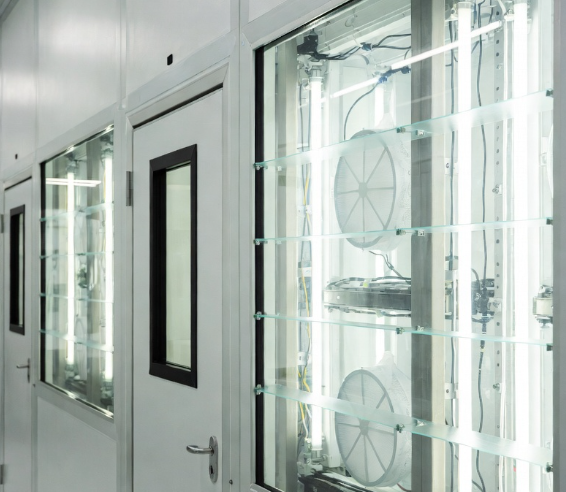
Standard doors, windows, airlocks, and pass-throughs offer only static separation. Manual handling, eyeball checks, and paper/verbal logs to delays, inconsistencies, and mistakes—worse during peak activity or urgent situations.
Smart technology adds sensors, automation, secure credentials, and live monitoring, converting these barriers into dynamic, intelligent parts of the cleanroom system.
Main benefits:
- Increased efficiency — Touch-free or badge-based access, auto-interlocks, and flow management cut delays, speed gowning/de-gowning, and support steady, low-disruption traffic with almost no manual effort.
- Improved safety & fast alerts — Sensors track door state, seal quality, pressure, and odd behavior in real time, instantly sounding alarms, notifying staff, isolating zones, or escalating when anything is wrong.
- Tighter contamination protection — Intelligent interlocks stop cross-opening in pressure zones; live pressure/airflow data keeps cascades stable during use; linked HVAC adjustments reduce particle carryover and turbulence, holding ISO classifications steady even with changing loads.
In short, smart tech evolves passive cleanroom elements into active safeguards—boosting dependability, audit strength, error reduction, quick issue handling, and risk control where zero defects is the only acceptable standard.
How Do Smart Clean Room Doors Work?
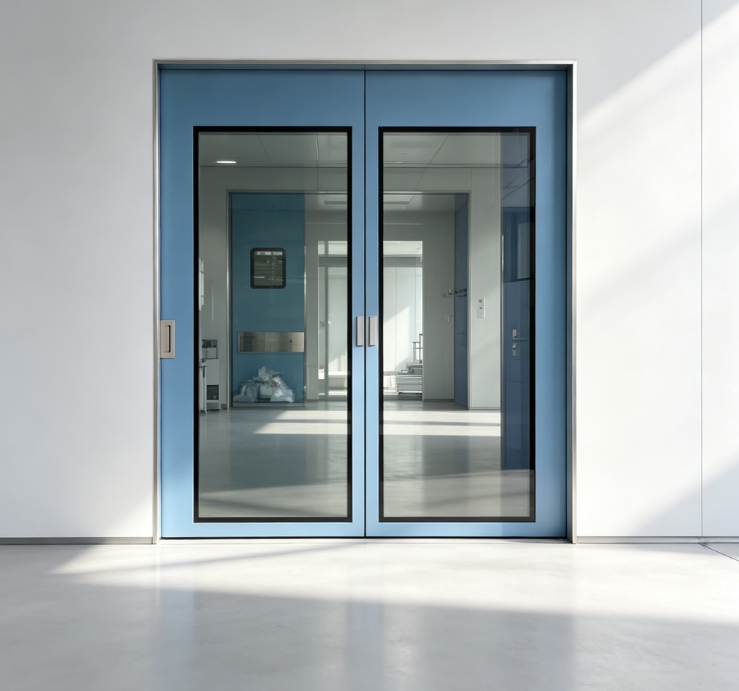
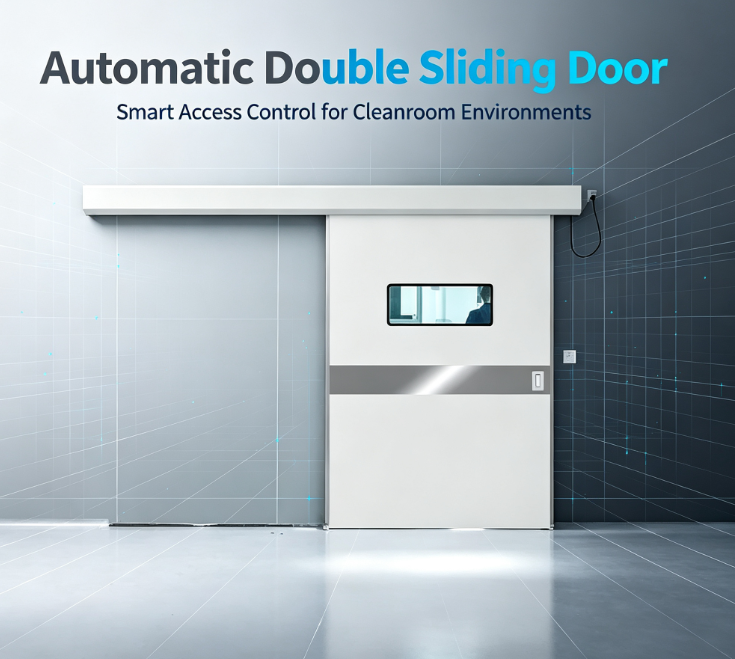
Smart clean room doors merge durable, sealed, particle-resistant construction with built-in sensors, automation, and controls to deliver precise, low-risk performance in controlled spaces.
They actively manage entry, motion, and conditions with little to no manual involvement.
Main features:
- Access Control — Entry requires verified credentials: key cards, PINs, biometrics (fingerprint, iris, facial), or mobile apps. Unauthorized access is blocked at once, with every attempt logged for audits.
- Automated Motion — Proximity, motion, or foot sensors drive smooth, speed-controlled opening/closing to reduce air disruption. Interlocks guarantee sequential operation in airlocks and pressure zones—no simultaneous openings—to protect differentials and stop contamination transfer.
- Environmental Monitoring & Correction — Sensors watch pressure, airflow, and (in advanced models) particles continuously. If issues arise (e.g., prolonged open state), the system sends alerts, tweaks HVAC, or runs recovery steps to quickly restore balance.
In summary, smart doors remove manual effort, visual checks, and human mistakes, ensuring steady, contamination-safe operation and reliable support for strict cleanroom protocols.
How Can Windows Benefit from Smart Features?
Clean room windows serve as vital environmental barriers beyond simple viewing. Smart integration transforms them into responsive system elements that actively help preserve control and minimize risks.
Main smart benefits:
- Controllable Opacity — Switchable smart glass (electrochromic or polymer-dispersed) lets staff or automation instantly adjust transparency. It blocks stray light from affecting sensitive processes, reduces visual distractions, or ensures privacy without particle-trapping shades or films.
- Embedded Sensing — Sensors within the frame or glazing track local conditions—temperature, humidity, pressure difference, and occasionally particle levels—at the window itself. This data flows directly to the control system for fast detection and correction of any deviations.
- Remote Dashboard Access — All window statuses, real-time readings, alerts, and historical data are viewable from a central interface or mobile device. This replaces frequent physical checks, accelerates issue spotting, and strengthens record-keeping.
By connecting windows to the smart cleanroom infrastructure, facilities achieve better barrier integrity, fewer contamination vulnerabilities at observation points, less foot traffic near critical zones, and enhanced safety and compliance in precision-controlled environments.
Can Smart Doors and Windows Improve Workflow Efficiency?
In clean rooms, where delays disrupt sensitive operations and every interruption risks contamination, smart doors and windows improve efficiency by removing manual barriers, speeding movement, and letting staff concentrate on core responsibilities instead of wrestling with access points.
Automation eliminates the need to push heavy sealed doors, turn handles, or wait for slow manual cycles—saving time and reducing physical strain.
Main efficiency improvements:
- Faster access, fewer bottlenecks — Sensors and credential readers (cards, biometrics, mobile) open doors instantly for authorized personnel. No queues form at gowning areas, airlocks, or material pass-throughs—traffic flows smoothly and predictably.
- Immediate problem detection — Any fault (door not closing, seal breach, forced entry, or timeout) triggers real-time notifications via alarms, lights, or mobile alerts. Teams address issues before they cause production stops or re-cleaning.
- Stable conditions without extra effort — Automatic interlocks and sequenced closing preserve pressure gradients and airflow. Controlled-speed operation minimizes turbulence, so processes continue uninterrupted instead of pausing for environmental recovery.
These upgrades cut non-productive time, lower operator fatigue, and increase overall throughput. Personnel stay focused on inspection, handling, or documentation rather than mechanical tasks. A modest investment in smart systems typically yields clear gains in daily speed, consistency, and compliance with little added complexity.
Are Smart Clean Room Solutions Cost-Effective?
Smart doors and windows may have higher upfront costs, but the long-term benefits are significant.
- Maintenance Reduction: Automated alerts detect issues early, reducing repair costs.
- Energy Efficiency: Automated closing and opening help maintain temperature and pressure, lowering HVAC load.
- Operational Savings: Time saved on manual operations translates into efficiency gains.
| Feature | Traditional Doors & Windows | Smart Doors & Windows |
|---|---|---|
| Manual Operation | Required | Reduced |
| Access Control | Limited | Advanced |
| Environmental Monitoring | None | Integrated |
| Maintenance Alerts | Reactive | Proactive |
| Workflow Efficiency | Moderate | Improved |
This table illustrates how smart integration enhances efficiency, safety, and operational oversight without increasing maintenance complexity.
How Do Smart Systems Support Contamination Control?
Clean rooms tolerate zero compromise on cleanliness—a single particle, pressure breach, or protocol violation can destroy product value, invalidate batches, or invite regulatory penalties. Smart systems go far beyond static barriers by actively monitoring, controlling, and responding to risks at every access point and environmental interface.
They provide multi-layered, real-time protection through these essential mechanisms:
- Seamless Airflow & Pressure Coordination — Smart doors integrate tightly with HVAC controls. Each open/close event automatically fine-tunes fan output, damper settings, or airflow rates to hold exact pressure cascades. Built-in sequencing ensures transitions never break differentials, drastically reducing turbulence and the chance of particles crossing zones.
- Ironclad Access Enforcement — Entry demands verified credentials—cards, biometrics, or mobile tokens. Unauthorized attempts are instantly rejected, recorded, and alarmed. Interlocking rules prevent out-of-sequence openings or bypassing airlocks, guaranteeing gowning procedures and directional flow are followed without fail.
- Non-Stop Sensing & Rapid Correction — Sensors throughout doors, windows, and frames continuously check pressure, airflow direction, seal tightness, and (in equipped models) local particle counts. Any irregularity—extended open duration, seal degradation, pressure swing—generates immediate alerts to personnel or automation systems, enabling swift fixes before contamination can spread.
Smart doors and windows function as vigilant, always-on guardians that close gaps left by human oversight, remove reliance on manual inspections, and preserve environmental conditions regardless of shift changes or workload fluctuations. The outcome is a dramatic drop in contamination incidents, stronger protection for high-value processes, and more dependable compliance in environments where even minor deviations carry unacceptable consequences.
What Factors Affect the Performance of Smart Clean Room Doors and Windows?
The true performance of smart clean room doors and windows comes down to four main areas: component quality, correct setup, system harmony, and resilience to the environment.
Key influencing factors:
- Sensor Accuracy & Reliability — Only high-precision sensors provide dependable detection of motion, pressure changes, seal status, or particles. Inferior sensors create frequent false triggers, ignored alerts, or delayed detection, weakening the whole system's credibility.
- Effective System Integration — Doors and windows need tight, error-free connection to HVAC automation, access management, BMS, and alarm networks. Any weak link results in uncoordinated actions, such as pressure drops during door cycles or alerts that never reach operators.
- Installation Quality & Precision — Perfect frame alignment, uniform seal compression, vibration-free mounting, and gap-free fitting are non-negotiable. Even minor errors in placement or sealing destroy airtight performance, misalign sensors, and accelerate wear—negating the value of advanced features.
- Suitability for Clean Room Stressors — Continuous cycles of humidity control, temperature shifts, aggressive cleaning/sterilization chemicals, and low-level airborne contaminants gradually affect seals, electronics, and mechanisms. Components not purpose-built for these conditions degrade faster and demand more frequent service.
Can Smart Technology Adapt to Future Clean Room Needs?
Clean rooms often evolve with new processes or stricter regulations. Smart doors and windows provide flexibility for future requirements.
- Scalability: Additional sensors or access points can be added as facility needs grow.
- Software Updates: Many smart systems allow updates that improve monitoring, reporting, and automation.
- Data Integration: Historical data helps optimize workflows, maintenance schedules, and environmental management strategies.
Smart technology ensures that clean room infrastructure can evolve without extensive physical modifications.
Additional Benefits of Smart Clean Room Doors and Windows
Beyond contamination control and efficiency, these systems offer secondary advantages.
- Safety Monitoring: Real-time alerts can prevent accidents and respond to emergencies quickly.
- Energy Management: Automated operation minimizes heat loss or gain, reducing energy costs.
- Enhanced Oversight: Centralized dashboards allow management to monitor multiple rooms from a single location.
The integration of smart doors and windows transforms clean rooms into responsive, adaptive environments. Workers, managers, and processes all benefit from more accurate control and oversight.