English
 русский
 Español
In industries where precision and purity are paramount—such as pharmaceuticals, biotechnology, microelectronics, and aerospace—cleanrooms serve as the backbone of operations. These controlled environments are designed to minimize airborne particles, microbes, and other contaminants that could compromise product quality or human health. At the heart of maintaining this delicate balance are cleanroom windows, specialized glazing systems that go beyond mere visibility. They play a crucial role in enhancing both sterility and safety, ensuring that observers, technicians, and processes remain protected without introducing risks.
Content
What Exactly Is a Cleanroom?
A cleanroom is a specially engineered space that keeps airborne dust, microbes, aerosol particles, and chemical vapors under extremely strict control—often to near-zero levels.
Every surface, the air system, lighting, furniture, and even people's clothing are chosen to shed virtually no particles. Powerful HEPA or ULPA filters constantly clean the air, while temperature, humidity, and pressure are tightly regulated to prevent contamination from condensation or static.
Anyone entering must wear full-body non-shedding suits, hoods, gloves, and booties, pass through air showers, and bring only cleanroom-approved tools and materials.
Cleanrooms are essential wherever a single speck can ruin a product or endanger lives—such as semiconductor manufacturing, pharmaceutical filling, biotech cell therapy labs, aerospace optics assembly, and sterile drug compounding. In short, a cleanroom is the ultimate protective shield between the outside world and a process that demands absolute purity.
What Is the True Function of Cleanroom Windows?
Cleanroom windows are far more than simple viewing panels. They are active, engineered components that directly support contamination control, process safety, operational efficiency, and regulatory compliance. Here are their core functions, explained clearly.
| Function | How the window achieves it | Direct benefit to sterility & safety | |
|---|---|---|---|
| 1 | Visual monitoring without entry | Flush-glazed, crystal-clear panels allow supervisors, QA, and maintenance to observe processes from the "dirty" side | Reduces gowning and door openings by 50–80 % → dramatically lowers particle and microbial ingress |
| 2 | Zero particle / microbial traps | Completely flush mounting, no exposed screws or ledges, smooth non-porous surfaces | Eliminates hidden crevices where dust or bacteria can hide |
| 3 | Airtight pressure cascade integrity | Gel-sealed or dry-gasket systems tested to <0.01 cfm/ft² leakage | Maintains positive or negative pressure differentials; prevents cross-contamination between zones |
| 4 | Controlled light & UV management | Tinted, low-E, or UV-blocking interlayers; optional switchable smart glass | Protects light-sensitive drugs, biologics, and silicon wafers while keeping glare low for operators |
| 5 | Structural & personnel protection | Laminated, tempered, or polycarbonate construction; fire-rated and blast-resistant options | Prevents glass shards in case of impact or explosion; contains fire and smoke for safe evacuation |
| 6 | Easy, non-shedding cleaning | Hard, non-porous surfaces compatible with IPA, H₂O₂ vapor, and VHP cycles | Allows frequent sanitisation without degrading the window or releasing particles |
Quick-Reference Safety Options
| Safety need | Window solution typically used | Real-world outcome |
|---|---|---|
| Impact / breakage protection | Tempered + PVB laminated glass or solid polycarbonate | Remains in frame even when cracked — no flying shards |
| Fire containment | Fire-rated glazing with intumescent seals | 45–120 minutes of fire & smoke barrier |
| Explosion risk | Polycarbonate interlayer, tested to 5–10 psi | Survives overpressure events without breaching the envelope |
| Radiation shielding | Leaded glass (1.0–3.0 mm Pb equivalent) | Safe observation of radio-pharmacy hot cells |
| Chemical resistance | Chemically strengthened glass or coated surfaces | Withstands repeated exposure to aggressive disinfectants |
| EMI/RF shielding | Embedded copper mesh or ITO conductive coating | Protects sensitive electronics from external interference |
A properly specified cleanroom window does six things at once: it lets you see, it keeps contaminants out, it holds pressure, it protects people, it survives harsh cleaning, and it never becomes a weak link in the controlled environment. That is why windows are considered critical engineering controls, not just architectural features.
What types of windows are used in cleanrooms?
Cleanroom windows are never one-size-fits-all. Depending on the process, the risk level, and the layout of the facility, different specialized designs are used. Here are the important variations you will actually encounter in real-world cleanrooms.
Viewport Windows
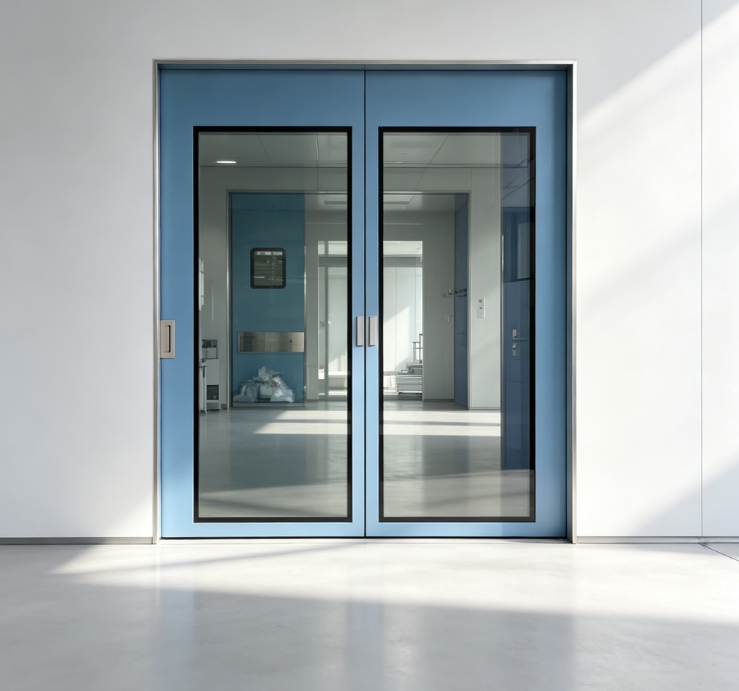
These are the classic observation windows people picture first. They are fixed, permanently sealed panels set flush into the wall so that supervisors, quality inspectors, or visitors can watch the process without ever stepping inside. Viewports are usually placed at eye level beside doors, along corridors overlooking production suites, or between gowning areas and the clean core. Because they never open, they present virtually zero risk of contamination once installed correctly.
Access Windows (also called Pass-Through Windows or Transfer Hatches)
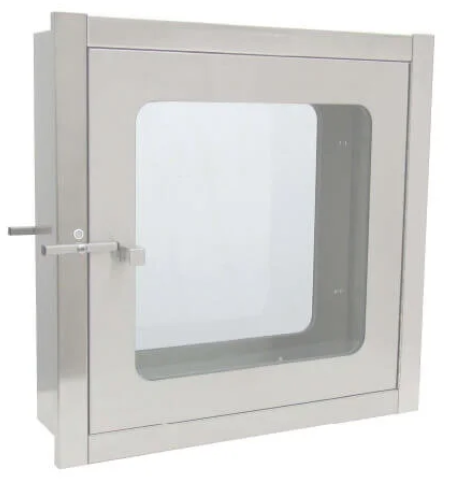
Unlike simple viewports, these windows do open, but in a highly controlled way. Their job is to move tools, samples, components, or finished product in and out of the cleanroom without forcing a person to enter or exit. They normally consist of two interlocked doors (when one side is open, the other is mechanically or electronically locked). Many are equipped with HEPA-filtered air purge, UV lamps, or ionizers that run automatically between transfers to knock down particles. In pharmaceutical and biotech facilities you'll see stainless-steel pass-throughs built into the wall at waist height; in microelectronics they are often larger to accommodate wafer cassettes.
Double-Glazed (or Insulated) Windows
In cold climates or facilities with large temperature differences between inside and outside, single-pane glass would sweat and create condensation inside the cleanroom — a breeding ground for microbes. Double-glazed (and sometimes triple-glazed) units with inert gas fill and low-emissivity coatings solve this problem. They keep the inner surface of the glass close to room temperature, prevent fogging, and cut heat loss or gain dramatically. Even though they have two or three layers, the cleanroom side is still perfectly flush and cleanable; the extra pane and spacer are hidden on the non-clean side of the wall.
Beyond these three everyday categories, many facilities also use fire-rated windows (with intumescent seals that swell in heat), lead-shielded windows for radiopharmacies, electrically switchable privacy glass for patient-specific cell therapy rooms, and blast-resistant windows in plants handling solvents or energetic materials. Each type is chosen not for looks, but because it solves a specific sterility, safety, or operational problem that a standard window simply cannot.
Why Choose YD-Purification's Cleanroom Windows?
When a facility's success depends on zero excursions, zero downtime, and zero weak points, the window you specify matters more than people realize. Learn how to choose YD-Purification purification windows for critical environments.
True Cleanroom-Grade Hygiene
Every YD window is flush-glazed on the cleanroom side with no exposed screws, no recessed ledges, and no silicone beads that can crack or harbor microbes over time. The result is a perfectly smooth surface that wipes down in seconds and never becomes a hidden contamination trap.
Rock-Solid Airtight Performance
Their windows consistently test below 0.01 cfm/ft² leakage — far better than many competitors — thanks to precision-machined frames and closed-cell gel or vulcanized EPDM gaskets. This means your pressure cascade stays exactly where you set it, shift after shift, year after year.
Built to Survive Real-World Cleaning
The glass is chemically tempered, the frames are 304 or 316L stainless, and every seal is validated against daily 70 % IPA, hydrogen peroxide vapor, and chlorine dioxide cycles. No yellowing, no crazing, no delamination even after a decade of aggressive sanitization.
Crystal-Clear Visibility Without Compromise
Optical-grade clarity combined with optional low-iron glass and anti-reflective coatings gives operators and supervisors an unobstructed view of the process. Fewer door openings = fewer gowning events = dramatically lower particle and microbial risk.
Truly Custom — Not Just "Cut to Size"
Whether you need fire-rated, double-glazed insulated units for a cold climate, lead-lined for a hot cell, switchable privacy glass for a cell-therapy suite, or 3-meter-tall full-height vision panels, yuanda builds exactly what the project demands instead of forcing you to adapt to an off-the-shelf catalog.
One-Stop Seamless System Integration
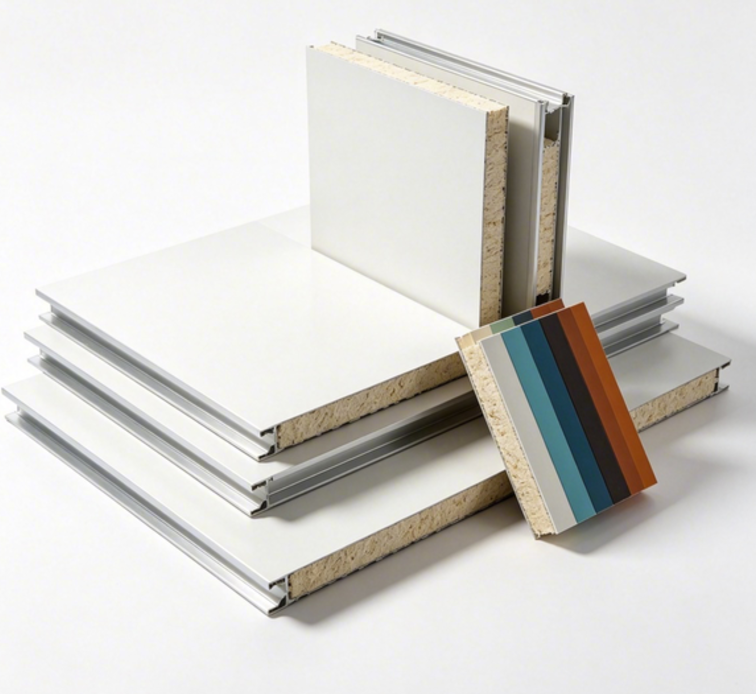
Because Yuanda also manufactures the modular wall panels, doors, ceilings, and pass-throughs, every window arrives pre-engineered to mate perfectly with the rest of the envelope. No field modifications, no mismatched tolerances, no last-minute sealant nightmares during validation.
YD-Purification windows aren't the option on the quotation sheet — but they are the ones that never cause an audit finding, never trigger a batch rejection, and never need replacing halfway through a facility's life. For teams that measure success in consistent yield and patient safety instead of initial cost, that difference is everything.