English
 русский
 Español
A high speed rolling shutter door is a type of industrial door designed to open and close quickly while maintaining separation between two environments. It is often used in spaces where movement, airflow, or temperature needs to stay under control.
Unlike traditional doors that move slowly and rely on heavy panels, this type of door uses a flexible curtain that rolls up and down in a guided system. The movement is smooth and controlled, allowing frequent access without long waiting times.
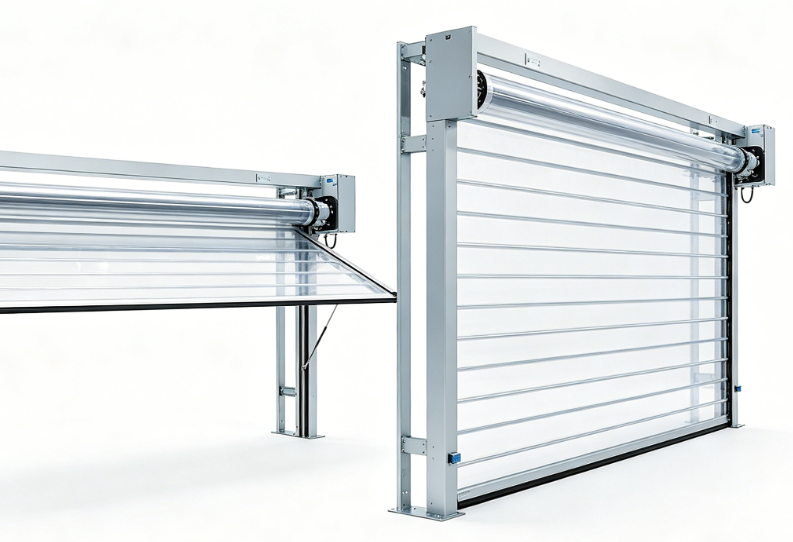
The design focuses on balancing speed and separation. It allows people, vehicles, or materials to pass through while limiting the exchange of air, dust, or outside conditions.
In many facilities, the door is not treated as a simple entry point. It becomes part of the environmental flow between spaces.
Content
- 1 Why Is Speed an Important Part of Its Design?
- 2 How Does the Rolling System Work?
- 3 What Materials Are Used in the Door Curtain?
- 4 How Is Movement Controlled Without Sudden Impact?
- 5 How Does It Help Control Airflow Between Spaces?
- 6 What Makes the Structure Suitable for Frequent Use?
- 7 How Does Safety Fit Into the Design?
- 8 Where Are High Speed Rolling Shutter Doors Commonly Used?
- 9 How Does Cleaning and Maintenance Influence Design?
- 10 How Does It Differ from Traditional Shutter Systems?
- 11 How Do Design Elements Work Together?
Why Is Speed an Important Part of Its Design?
Speed is not only about convenience. It directly affects environmental stability. When a door stays open for a long time, the difference between two spaces becomes less controlled.
A fast-moving door reduces the time the opening is exposed. This helps maintain internal conditions more consistently.
The concept can be understood in a simple way:
- Short opening time reduces outside influence
- Faster closure helps restore internal balance
- Frequent use becomes more manageable
- Movement between zones becomes smoother
Speed also supports workflow efficiency. In busy environments, waiting time can interrupt operations. A fast response helps keep movement continuous.
The door does not rely on forceful motion. It relies on controlled acceleration and smooth rolling behavior.
How Does the Rolling System Work?
The core mechanism is based on a rolling movement. Instead of swinging open or sliding sideways in a rigid structure, the door curtain moves along a guided path and rolls into a compact form.
This system allows the door to occupy minimal space when open. The movement is usually vertical, but the key idea is controlled rolling rather than rigid folding.
A simple breakdown of the movement process:
- The system receives an activation signal
- The curtain begins to move along its guided track
- The material rolls into a compact position above the opening
- The passage becomes fully or partially open
- When closing, the curtain returns along the same path
The process is smooth and continuous. Sudden movement is avoided to maintain stability in the surrounding environment.
What Materials Are Used in the Door Curtain?
The curtain is one of the visible parts of a high speed rolling shutter door. Its material is selected to balance flexibility, strength, and environmental resistance.
It must be light enough to move quickly but strong enough to maintain shape during repeated use.
Common material characteristics
| Feature | Purpose |
|---|---|
| Flexible structure | Supports rolling movement |
| Surface stability | Reduces wear during operation |
| Environmental resistance | Handles changing conditions |
| Smooth finish | Limits dust accumulation |
The surface is often designed to stay uniform. Uneven texture can affect both movement and cleaning. A stable surface also helps reduce unwanted particle buildup.
In some cases, layered structures are used to improve durability without increasing weight.
How Is Movement Controlled Without Sudden Impact?
Movement control is a key part of the system. Even though the door operates at a fast pace, the motion must remain stable.
If the movement is too abrupt, it can create air disturbance or mechanical stress. To avoid this, the system is designed to guide motion in a steady path.
The control system usually manages:
- Opening and closing speed adjustment
- Smooth start and stop behavior
- Balanced force distribution during movement
- Stable alignment of the curtain during travel
Instead of relying on a single forceful action, the motion is distributed across the entire movement cycle.
This helps maintain both mechanical stability and environmental consistency.
How Does It Help Control Airflow Between Spaces?
One of the main functions of a high speed rolling shutter door is controlling airflow between different areas.
When two spaces have different conditions, such as temperature or cleanliness level, open passages can create imbalance. The door helps reduce this effect by limiting exposure time.
A comparison helps clarify the role:
| Situation | Effect without fast door | Effect with fast door |
|---|---|---|
| Frequent access | Long exposure between spaces | Short exposure time |
| Air movement | Higher uncontrolled exchange | Reduced transfer window |
| Environmental stability | Fluctuates more easily | More consistent balance |
The key idea is time control. Less time open means less external influence.
The door does not eliminate airflow completely. It manages the interaction between environments in a controlled way.
What Makes the Structure Suitable for Frequent Use?
In many environments, the door is used repeatedly throughout the day. This requires a structure that can handle continuous operation without losing alignment or smoothness.
The frame supports the guiding system, keeping the curtain in place during movement. The rolling mechanism reduces friction compared to rigid sliding systems.
The structure is designed around repetition. It is expected to operate many times without noticeable change in performance.
Key structural considerations include:
- Stable frame alignment
- Consistent rolling path
- Balanced load distribution
- Reduced wear points
- Secure connection between moving parts
Instead of focusing on complexity, the design focuses on reliability through repetition.
How Does Safety Fit Into the Design?
Safety is an important part of operation, especially in environments where people and equipment move frequently.
The door is designed to respond smoothly to obstacles or interruptions. Movement is controlled to reduce sudden contact or unexpected closure behavior.
Safety design often includes:
- Controlled movement speed
- Soft response during closing
- Stable guidance to prevent deviation
- Clear visibility of moving parts
- Reduced risk of sudden mechanical impact
The goal is predictable behavior. When movement is predictable, users can interact with the system more confidently.
Where Are High Speed Rolling Shutter Doors Commonly Used?
These doors are used in many controlled and active environments. Their design supports spaces where movement and separation must work together.
They are often found in areas such as:
- Production and assembly zones
- Storage and logistics passages
- Controlled indoor environments
- Areas with frequent material transfer
- Spaces requiring separation between clean and non-clean zones
In each case, the role remains similar. The door helps manage transitions between different conditions.
It is not only about access. It is about maintaining balance between connected spaces.
How Does Cleaning and Maintenance Influence Design?
Cleaning requirements affect how the door is shaped and finished. Smooth surfaces are easier to maintain, especially in environments where dust or particles are a concern.
Maintenance is also linked to movement consistency. A stable system requires less adjustment over time.
Design choices often focus on:
- Simple surface geometry
- Reduced edge complexity
- Stable material behavior under repeated cleaning
- Easy access for inspection
- Consistent movement without frequent adjustment
The goal is to keep operation stable without frequent interruption.
How Does It Differ from Traditional Shutter Systems?
Traditional shutter systems often move slowly and rely on heavier structural elements. They are designed for basic separation rather than frequent operation.
A high speed rolling shutter door changes this approach by focusing on movement efficiency and controlled environmental interaction.
The difference can be summarized in structure and behavior:
| Aspect | Traditional shutter | High speed rolling shutter |
|---|---|---|
| Movement speed | Slower and heavier | Faster and smoother |
| Operation style | Rigid motion | Flexible rolling |
| Environmental control | Basic separation | Controlled exposure |
| Usage frequency | Moderate | Frequent |
The shift is not about replacing function. It is about adapting to environments where movement happens more often and conditions need closer control.
How Do Design Elements Work Together?
Each part of the door system contributes to a larger function. The curtain, frame, rolling system, and control mechanism are not separate ideas. They work as a connected structure.
The curtain manages separation. The frame provides stability. The rolling system supports movement. The control system coordinates timing.
When these elements work together, the result is a door that responds quickly while maintaining environmental balance.
The design is built around coordination rather than isolated performance.
Every movement is part of a repeated cycle, shaped by the same structural logic each time it operates.