English
 русский
 Español
Content
- 1 Why are fire resistant sandwich panels becoming part of modern building discussions?
- 2 What is the basic structure of a fire resistant sandwich panel?
- 3 How does layered construction influence fire behavior?
- 4 Why does core material play a central role in performance?
- 5 How does heat travel through layered materials?
- 6 Why is structural stability important during high temperature exposure?
- 7 How does surface layer behavior influence early heat response?
- 8 How do fire resistant sandwich panels behave in real building environments?
- 9 What factors can influence overall fire resistance behavior?
- 10 Why do these panels fit into modern construction design trends?
- 11 How does layered design influence long-term building safety planning?
Why are fire resistant sandwich panels becoming part of modern building discussions?
In recent years, building design has shifted toward materials that combine structure, insulation, and safety performance. Fire resistant sandwich panels are often mentioned in this context.They are used in walls, roofs, and partition systems where both structural support and fire safety considerations are needed.

What draws attention is not only their presence in construction, but the way they respond to high heat conditions compared with standard building panels.
Instead of acting as a single solid layer, they rely on a combined structure. This layered approach changes how heat moves through a surface and how materials react when exposed to rising temperatures.
Their role is not limited to one building type. They appear in industrial spaces, commercial environments, and controlled indoor facilities where safety planning is part of daily design thinking.
What is the basic structure of a fire resistant sandwich panel?
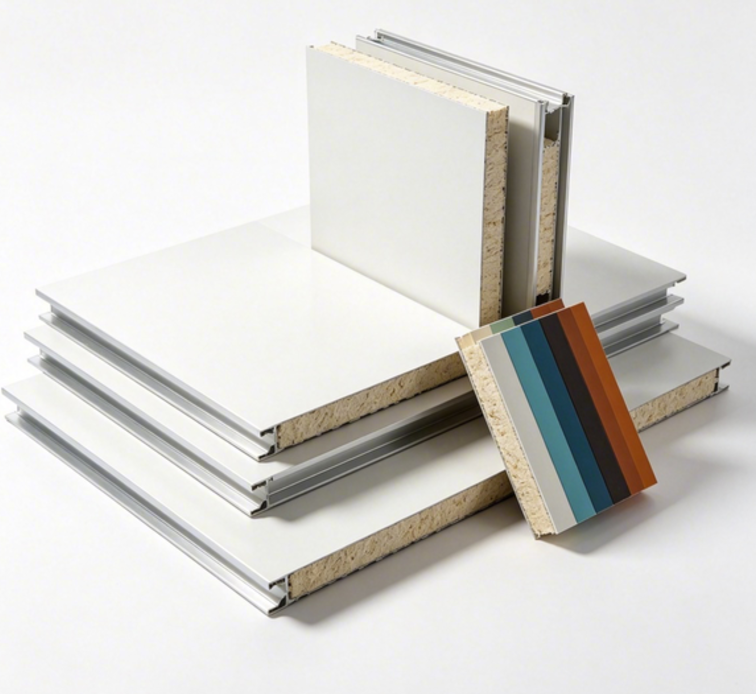
Fire resistant sandwich panels are put together with multiple layers stuck firmly into one whole piece.
Each layer has its own practical function. The outer layer guards the surface, and other parts split the structure inside. The middle core is specially made to hold back heat, stopping it from moving quickly from one side to the other.
The design is easy to understand. It never counts on just one material to fight fire. Every layer shares the work and works as a whole.
When the panel is exposed to intense heat, the layered structure won't react all at once. Heat seeps through bit by bit.
The outer surface gets affected first. The middle layer acts differently, and the inner side only feels the heat after a long while.
This time difference is what makes the panel good at stopping fire from spreading.
How does layered construction influence fire behavior?
Fire spreads through a combination of heat transfer, surface exposure, and material response.
A single solid surface tends to allow faster and more direct heat movement. In contrast, layered structures interrupt that movement.
Inside a fire resistant sandwich panel, heat does not travel in a straight path. It encounters different material zones along the way.
Each zone changes how energy behaves. Some areas slow down heat movement. Others reduce temperature transfer. Some create resistance that limits direct progression.
This creates a step-by-step reduction effect.
| Structure Type | Heat Movement | Result in Building Use |
|---|---|---|
| Single layer surface | Direct transfer | Faster heat spread |
| Layered panel system | Interrupted transfer | Reduced heat movement |
The difference is not immediate. It builds gradually as heat interacts with multiple internal boundaries.
Why does core material play a central role in performance?
The core is the key part that determines how well a fire-resistant sandwich panel works. Sandwiched between two outer skins, it acts as a dividing layer.
When heat gets into the panel, the core slows it down so it can't pass through rapidly. It won't block heat entirely, but it cuts down its speed and intensity.
How the core works also relies on how well it pairs with the outer materials. A solid, stable core lets the panel perform steadily under high temperatures. If the core is poor quality or inconsistent, the whole panel will work unpredictably.
Simply put, the core works like a buffer. It soaks up heat and holds it back from spreading further.
How does heat travel through layered materials?
Heat spreads in more than one way. It moves directly through materials, transfers across surfaces and seeps through gradually.
Things get more complicated with multi-layer fire-resistant panels. Every layer forms a new boundary, which slows heat down as it passes through.
Some heat is lost each time it crosses from one layer to the next. Heat can no longer flow straight through; it has to shift and adapt to different materials.
This process greatly delays heat from reaching the other side of the panel. All the small slowdowns add up, and overall heat transfer becomes much slower.
Why is structural stability important during high temperature exposure?
During exposure to high heat conditions, structural stability becomes a key factor.
A panel must maintain its shape and connection between layers. If layers separate or deform too easily, the protective function weakens.
Sandwich panels are designed to keep internal structure aligned even under stress conditions.
This stability ensures that layers continue to work together instead of breaking apart.
If structure remains intact, heat transfer remains controlled. If structure weakens, heat movement becomes less predictable.
In real building environments, this stability supports consistent behavior across different installation areas.
How does surface layer behavior influence early heat response?
The outer surface is the first part of the panel exposed to heat.
Its role is to manage initial contact. It influences how quickly heat enters the internal structure.
A stable surface layer reduces sudden transfer and helps distribute heat more evenly across the panel.
Without this step, heat would move quickly into deeper layers, reducing overall performance.
The surface does not work alone. It works as a starting point for layered resistance.
Once heat passes the surface, it enters a more complex internal system where movement slows down further.
How do fire resistant sandwich panels behave in real building environments?
In real applications, these panels are rarely used in isolation.
They are installed as part of wall systems, ceiling structures, and partition designs.
Their performance depends not only on material structure but also on how they interact with surrounding building elements.
In enclosed spaces, they help slow down heat movement between sections. In open industrial environments, they contribute to controlled separation between functional areas.
Their effect becomes more noticeable when multiple panels are used together in a consistent layout.
This creates a structured environment where heat movement is influenced across larger surface areas rather than single points.
What factors can influence overall fire resistance behavior?
Even though fire resistant sandwich panels are designed for stable performance, real-world conditions can influence results.
Some of these factors include:
- Installation alignment between panels
- Contact with surrounding structural materials
- Surface connection quality
- External heat source distribution
These factors do not eliminate function, but they can change how evenly performance is distributed.
Fire behavior in buildings is rarely influenced by one material alone. It is usually the result of combined system design.
That is why installation consistency is as important as material composition.
Why do these panels fit into modern construction design trends?
Modern construction often focuses on combining multiple functions into fewer building components.
Instead of separating structure, insulation, and safety systems, designers look for integrated materials.
Sandwich panels fit into this approach because they combine structure and protective behavior in one system.
They also support flexible design layouts. Panels can be used in different building types without changing core installation logic.
This reduces complexity during planning and allows more consistent building performance across different environments.
The focus is not only on material strength, but on system behavior within the building as a whole.
How does layered design influence long-term building safety planning?
Long-term building performance depends on how materials behave over time under different conditions.
Layered design provides a way to manage this behavior in stages rather than relying on a single material response.
Each layer continues to perform its role even when conditions change.
This creates a more controlled reaction to environmental stress.
In safety planning, predictability is often more important than intensity of performance.
Fire resistant sandwich panels support this by creating a structured response to heat rather than an immediate single-layer reaction.
That controlled response is what makes them widely used in environments where safety design is part of long-term planning.